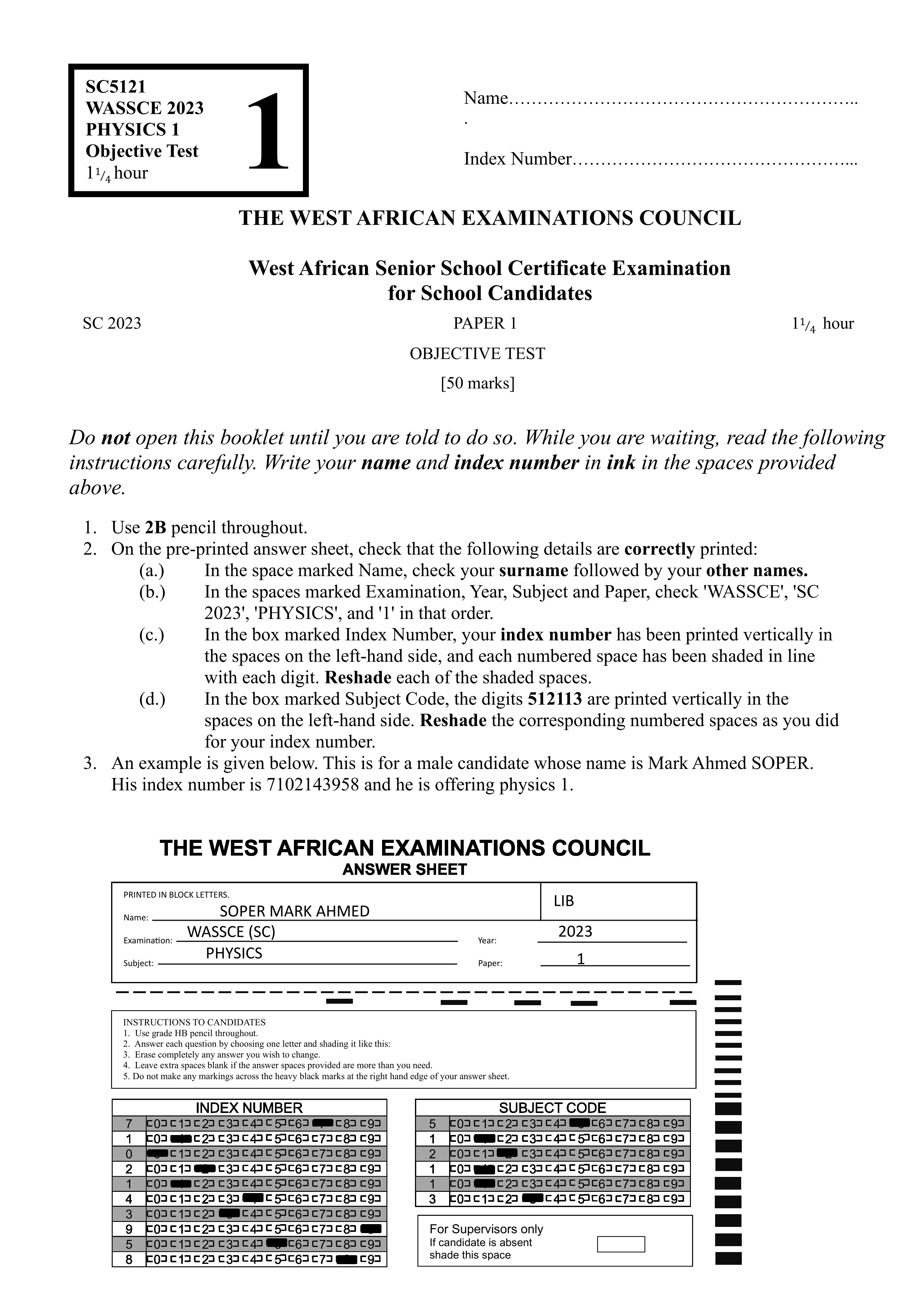
Each question is followed by four options lettered A to D. Find the correct option for each question and shade in pencil on your answer sheet, the answer space which bears the same letter as the option you have chosen. Give only one answer to each question. An example is given below.
A body starts moving with a speed of 40 m s−1 and accelerates uniformly to 90 m s−1 in 4.0 s. Calculate the distance travelled.
A. 100 m B. 180 m C. 200 m D. 260 m
The correct answer is 260 m, which is lettered D, and therefore answer space D would be shaded.
Think carefully before you shade the answer spaces; erase completely any answer(s) you wish to change.
Do all rough work on this question paper.
Now answer the following questions.
1. The instrument used to measure relative humidity is a
Explanation:
The correct answer is: B. Hygrometer
A hygrometer measures the amount of moisture (humidity) in the air.
Here's why the other answers are incorrect:
A. Hydrometer: Measures the density of liquids.
C. Manometer: Measures pressure differences in gases or liquids.
D. Barometer: Measures atmospheric pressure.
2. Which part of the human eye performs the same function as the diaphragm in a lens camera?
Explanation:
The correct answer is: A. Iris
The iris controls how much light enters the eye by adjusting the size of the pupil — just like the diaphragm in a camera controls the size of the aperture.
Here's why the other answers are incorrect:
B. Cornea: Helps focus light, like a camera lens.
C. Retina: Receives the image, like a camera's sensor.
D. Choroid: Supplies the eye with nutrients and absorbs stray light.
3. An electron moves from an energy level of \(-8.6 \, \text{eV}\) to another level of \(-3.5 \, \text{eV}\). Determine the frequency of the absorbed radiation.
Note: The given conversion \( 1 \, \text{eV} = 1.6 \times 10^{-9} \, \text{J} \) leads to an unrealistic frequency. The standard conversion is \( 1.6 \times 10^{-19} \, \text{J} \). Using the correct value:
The frequency matches option D, indicating a likely typo in the problem's conversion factor.
4. A ball of mass 0.8 kg is dropped from a height, \( H \). Just before hitting the ground, its velocity is 5.0 m s\(^{-1}\). Determine \( H \). \([g = 10 \, \text{m s}^{-2}]\)
Explanation:
The correct answer is: D
Using the kinematic equation \( v^2 = u^2 + 2 a s \), where \( v = 5.0 \, \text{m/s} \), \( u = 0 \, \text{m/s} \), \( a = g = 10 \, \text{m/s}^2 \), and \( s = H \):
\[
\begin{aligned}
(5.0)^2 &= (0)^2 + 2 \times 10 \times H \\[1em]
25 &= 20 H \\[1em]
H &= \frac{25}{20} \\[1em]
&= 1.25 \, \text{m}
\end{aligned}
\]
Alternatively, using energy conservation (\( m g H = \frac{1}{2} m v^2 \)) yields the same result, confirming \( H = 1.25 \, \text{m} \).
5. Which of the following statements about latent heat are correct?
I. When ice melts, latent heat is absorbed.
II. When water freezes, latent heat is given off.
III. When water evaporates, latent heat is absorbed.
IV. When water vapour condenses, latent heat is absorbed.
Explanation:
The correct answer is: B. I, II and III only
Latent heat is the heat absorbed or released during a change of state (solid ↔ liquid ↔ gas) without a change in temperature.
Here's why the other statements are incorrect/correct:
I. True: Ice absorbs heat to melt (solid → liquid).
II. True: Water releases heat to freeze (liquid → solid).
III. True: Water absorbs heat to evaporate (liquid → gas).
IV. False: Condensation releases heat (gas → liquid); heat is not absorbed.
6. Increasing the frequency of a sound wave produces a sound with
Explanation:
The correct answer is: B. Higher pitch
Frequency is how fast a sound wave vibrates. Higher frequency = more vibrations = a higher pitch.
Here's why the other answers are incorrect:
A. Reduced loudness: Loudness depends on amplitude, not frequency.
C. More overtones: Overtones depend on the source of the sound, not just frequency.
D. Longer wavelength: Higher frequency means shorter wavelength.
7. Which of the following diagrams correctly illustrates the mode of oscillation of air in a tube for the first overtone?
Explanation:
The correct answer is: A
For the first overtone (second harmonic) in a tube that is open at both ends:
There is a node in the middle.
There are antinodes at both ends.
Diagram A correctly shows this pattern.
Here's why the other answers are incorrect:
B: Shows more nodes than required — this represents a higher overtone.
C: Looks like the fundamental mode (only one antinode), not the first overtone.
D: Shows too many loops — this represents a higher harmonic.
8. In a mass spectrometer, an ion of charge, \( q \), and mass, \( m \), moving in a path of radius, \( r \), in a field of flux density, \( B \), has a speed of
Explanation:
The correct answer is: B
In a mass spectrometer, the ion moves in a circular path due to the magnetic force. The magnetic force \( q v B \) provides the centripetal force \( \frac{m v^2}{r} \). Setting them equal:
\[
\begin{aligned}
q v B &= \frac{m v^2}{r} \\[1em]
q B &= \frac{m v}{r} \quad (\text{divide by } v) \\[1em]
v &= \frac{q B r}{m}
\end{aligned}
\]
This matches option B, \( \frac{B q r}{m} \).
9. A sound of frequency 512 Hz reaches a listener 100 m away. If the sound travels in air at s.t.p., what is its wavelength? [speed of sound in air = 331 \( \text{m} \, \text{s}^{-1} \)]
Explanation:
The correct answer is: A
The wavelength \( \lambda \) is calculated using \( v = f \lambda \), where \( v = 331 \, \text{m} \, \text{s}^{-1} \) (speed) and \( f = 512 \, \text{s}^{-1} \) (frequency in Hz). Solving for \( \lambda \):
Units check: \( \frac{\text{m} \, \text{s}^{-1}}{\text{s}^{-1}} = \text{m} \), which is correct for wavelength. Thus, the wavelength is 0.646 m.
10. In the Rutherford scattering experiment, a beam of alpha particles was fired at a thin gold film and few of the particles were deflected considerably. This shows that the nucleus of an atom
Explanation:
The correct answer is: A
Only a few alpha particles were deflected because the nucleus is very small and carries a positive charge.
Most particles passed straight through the gold foil, showing that atoms are mostly empty space.
Here's why the other answers are incorrect:
B: The nucleus does not emit alpha particles in this experiment.
C: The nucleus does not contain alpha particles; alpha particles are just used as the probe.
D: Electrons are not found inside the nucleus — only protons (and neutrons).
11. A charge of 10 C is transferred across a potential difference of 220 V. Determine the work done.
Explanation:
The correct answer is: C
The work done \( W \) is calculated using the formula \( W = Q \cdot V \), where \( Q = 10 \, \text{C} \) (charge) and \( V = 220 \, \text{V} \) (potential difference):
\[
\begin{aligned}
W &= Q \cdot V \\[1em]
&= 10 \cdot 220 \\[1em]
&= 2200 \, \text{J}
\end{aligned}
\]
Thus, the work done is 2200 J.
12. A solenoid is constructed by winding an insulated copper wire on a long test tube. A constant direct current is passed through the solenoid. Which of the following actions will not increase the strength of the magnetic field of the solenoid? Inserting a
Explanation:
The correct answer is: A. Brass rod
The magnetic field of a solenoid becomes stronger when a magnetic (ferromagnetic) material is inserted inside it. Metals like soft iron, steel, and nickel increase the magnetic field.
Brass is **non-magnetic**, so inserting it will not increase the magnetic field.
Here's why the other answers are incorrect:
B. Soft iron: Strongly magnetic — greatly increases the field.
C. Steel: Magnetic — increases the field.
D. Nickel: Magnetic — increases the field.
13. The following statements are advantages of a solid dielectric material between the plates of a capacitor except that
Explanation:
The correct answer is: C
A dielectric is an **insulator**, so it prevents current from flowing across the plates. It increases capacitance and allows the capacitor to hold more charge safely.
Here's why the other answers are incorrect:
A: A dielectric increases the maximum voltage the capacitor can handle.
B: A dielectric increases capacitance.
D: It physically keeps the plates separated.
14. Which of the following statements about a ferromagnetic material is correct? It
Explanation:
The correct answer is: B. It has a high susceptibility
Ferromagnetic materials (like iron and nickel) are strongly attracted to magnets because they can become highly magnetized. This is due to their high magnetic susceptibility.
Here's why the other answers are incorrect:
A: Ferromagnets have high permeability, not low.
C: They attract magnetic materials — they do not repel them.
D: They do not attract non-magnetic materials.
15. A ball, P, is released from the roof of a building at the same time as another ball, Q, is thrown vertically upward from the base of the building. Which of the following statements is correct?
Explanation:
The correct answer is: A
Both balls experience the same acceleration due to gravity (g). Gravity always acts downward, regardless of whether the ball is moving up or down.
Here's why the other answers are incorrect:
B: The accelerations are not opposite — both are downward.
C: Neither ball has less acceleration — gravity is the same for both.
D: Gravity is constant, so the accelerations cannot be different.
16. A planet has mass, \( M \), and radius, \( R \), if the universal gravitational constant is \( G \), what is the expression for the escape velocity of an object on the planet?
Explanation:
The correct answer is: C
The escape velocity is the minimum speed required for an object to escape a planet’s gravitational pull, reaching infinity with zero kinetic energy. Using conservation of energy, the kinetic energy at the surface, \( \frac{1}{2} m v^2 \), equals the gravitational potential energy, \( \frac{G M m}{R} \). Setting them equal:
\[
\begin{aligned}
\frac{1}{2} m v^2 &= \frac{G M m}{R} \\[1em]
\frac{1}{2} v^2 &= \frac{G M}{R} \quad (\text{divide by } m) \\[1em]
v^2 &= \frac{2 G M}{R} \\[1em]
v &= \left( \frac{2 G M}{R} \right)^{1/2}
\end{aligned}
\]
This matches option C, \( \left( \frac{2 G M}{R} \right)^{1/2} \).
17. The specific latent heat of vaporization of lead is \( 8.7 \times 10^5 \, \mathrm{J \, kg^{-1}} \). This means that \( 8.7 \times 10^5 \, \mathrm{J} \) of thermal energy is required to change
Explanation:
The correct answer is: D
The specific latent heat of vaporization is the amount of thermal energy required to change 1 kg of a substance from liquid (molten) to vapor phase at constant temperature and pressure.
Here, the value \( 8.7 \times 10^5 \, \mathrm{J \, kg^{-1}} \) means:
\[
\text{Energy required} = 8.7 \times 10^5 \, \mathrm{J}
\]
to change
\[
1\, \mathrm{kg}
\]
of molten lead to vapour at constant temperature and pressure.
It does not apply to the solid phase directly, nor does it depend on temperature change during the phase transition.
Therefore, the correct answer is D.
18. A 100 kg device is pulled up a plane inclined at 30° to the horizontal with a force of 1000 N.
If the coefficient of friction between the device and the surface is 0.25, determine the total force opposing the motion.
[g = 10 m/s2]
Explanation:
The correct answer is: B
The forces opposing the motion are the component of the weight down the incline and the frictional force.
Given:
Mass, \( m = 100\, \mathrm{kg} \)
Incline angle, \( \theta = 30^\circ \)
Coefficient of friction, \( \mu = 0.25 \)
Gravity, \( g = 10\, \mathrm{m/s}^2 \)
19. Two objects A and B, accelerate from rest at uniform rates. B accelerates twice as much as A. Compared to A, B travels
Explanation:
The correct answer is: D
Both objects start from rest, with object A having acceleration \( a \) and object B having acceleration \( 2a \). Assuming they accelerate for the same time \( t \), the distance traveled is given by:
Thus, B travels twice as far as A, matching option D.
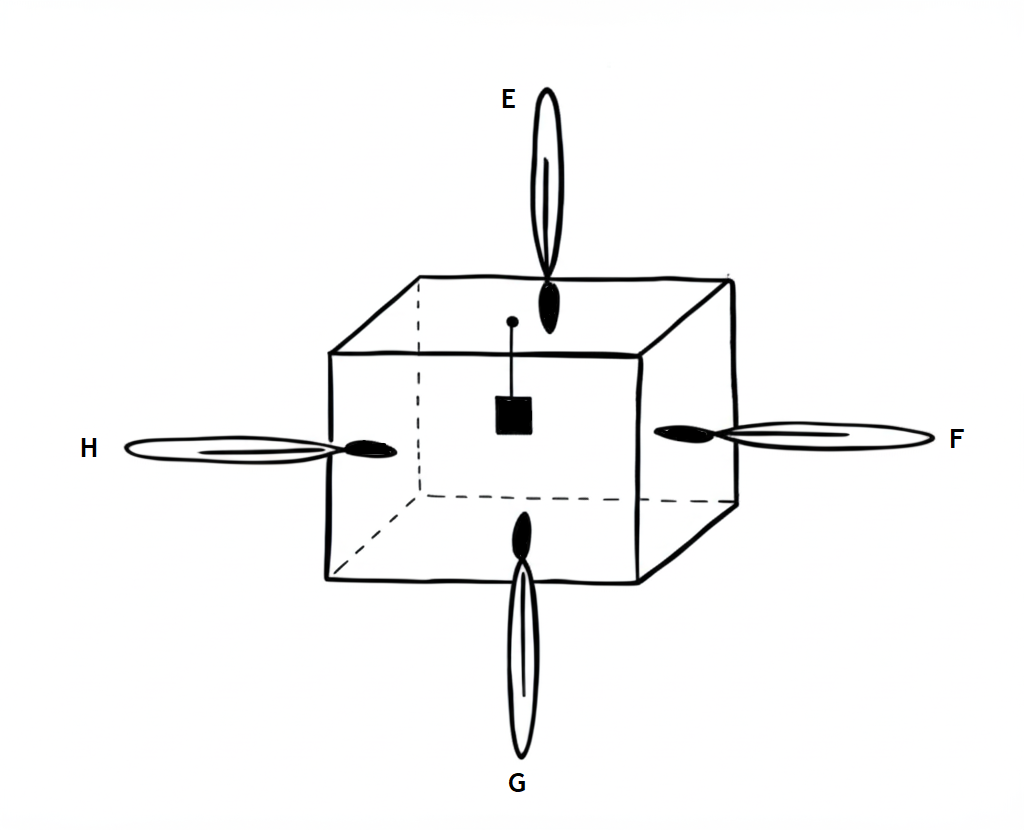
20.
The diagram above illustrates a hot metal suspended at the centre of a closed uniform box. Thermometers E, F, G, and H are placed in contact with four sides of the box. Which of the thermometers would register the highest temperature?
Explanation:
The correct answer is: D. E
Hot air rises. The hot metal warms the air around it, and this warm air moves upward to the top of the box, making the thermometer at the top (E) record the highest temperature.
Here's why the other answers are incorrect:
F and H: On the sides, so they measure medium temperature.
G: At the bottom — cold air sinks, so it records the lowest temperature.
21. A liquid is left in an open dish. After several days, there is less liquid in the dish. Which of the following statements explains this observation? The
Explanation:
The correct answer is: A
During evaporation, the most energetic molecules escape from the surface of the liquid into the air. This reduces the amount of liquid left in the dish.
Here's why the other answers are incorrect:
B: Least energetic molecules cannot escape the surface.
C: Least energetic molecules do not escape — they stay in the liquid.
D: Most energetic molecules do not return — they escape into the air.
22. The colors of the visible light region of the electromagnetic spectrum that have the shortest and longest wavelengths respectively are
Explanation:
The correct answer is: C. Violet and red
In visible light:
Violet has the shortest wavelength.
Red has the longest wavelength.
Here's why the other answers are incorrect:
A: Yellow and blue are not at the wavelength extremes.
B: Indigo does not have the shortest wavelength.
D: Red is longest, but blue is not the shortest.
23. Which of the following equations is not a correct mirror formula?
[The symbols have their usual meanings]
Explanation:
The correct answer is: A
Topic: Mirror Formula and Optics
The standard mirror and lens formulas include:
\[
\frac{1}{f} = \frac{1}{u} + \frac{1}{v}
\]
\[
m = \frac{v}{u}
\quad \text{and} \quad
f = \frac{1}{D} \quad \
\]
However, the formula
\[
N = \frac{360}{\theta} = -1
\]
is not related to mirror equations and does not make physical or mathematical sense in this context.
Hence, option A is not a valid mirror formula.
24. An atom in an excited state is one whose
Explanation:
The correct answer is: C
An atom becomes excited when it absorbs energy and one or more electrons jump to a higher energy level than normal.
Here's why the other answers are incorrect:
A: The excited state refers to electrons moving, not potential energy alone.
B: The conduction band refers to solids, not atoms.
D: Minimum energy means ground state, not excited.
25. The conclusive test for magnetism in a steel bar suspended horizontally at its midpoint is when the bar
Explanation:
The correct answer is: D
A magnet, when freely suspended, always aligns itself in the Earth's magnetic field, pointing North–South. This proves the bar is magnetized.
Here's why the other answers are incorrect:
A: A magnet aligns N–S, not E–W.
B: Repulsion is rare and depends on pole orientation.
C: Attraction is not conclusive — even unmagnetized magnetic materials can be attracted.
26. Which of the following devices is used to compare the relative magnitudes of charges on two given bodies?
Explanation:
The correct answer is: C
A gold leaf electroscope shows how much charge is present because the gold leaves diverge. The more they spread, the greater the charge on the object.
Here's why the other answers are incorrect:
A: An ebonite rod only becomes charged by rubbing — it does not measure charge.
B: A proof plane is only used to transfer charge.
D: An electrophorus produces charge, not measure it.
27. A direct current cannot pass through a parallel plate capacitor because
Explanation:
The correct answer is: C
The dielectric between capacitor plates is an insulator, so direct current cannot cross from one plate to the other.
Here's why the other answers are incorrect:
A: Capacitor plates having opposite charges does not stop DC flow — the dielectric does.
B: Leakage of charge is not the reason DC stops flowing.
D: The plates are conducting — it's the dielectric that blocks current.
28. The process of producing electric current by a changing magnetic field is referred to as
Explanation:
The correct answer is: B
Electromagnetic induction is the production of current when the magnetic field around a conductor changes.
Here's why the other answers are incorrect:
A: Not a standard term in electricity.
C: Electrostatic induction deals with charges, not current.
D: Flux linkage is related, but it is not the name of the process.
29. The sagging of overhead electrical wires is caused by
Explanation:
The correct answer is: B
When heated, metal wires expand and become longer, causing them to sag.
Here's why the other answers are incorrect:
A: Radiation does not stretch the wires — it's heat expansion.
C: Gravity acts on the wires, but thermal expansion is the real cause of sagging.
D: Handling wires does not cause permanent sagging.
30. A cell of emf 2 V has an internal resistance of 0.5 Ω. A current of 0.4 A passes through an
external resistor, P. Determine the resistance of P.
Explanation:
The correct answer is: B
Topic: Electrical Circuits – EMF and Internal Resistance
Using Ohm’s law and the formula for EMF:
\[
\text{EMF} = I(R + r)
\]
Where:
\( \text{EMF} = 2 \ \text{V} \)
\( I = 0.4 \ \text{A} \)
\( r = 0.5 \ \Omega \) (internal resistance)
\( R = \text{resistance of P} \)
Substitute into the equation:
\[
2 = 0.4(R + 0.5)
\]
Divide both sides by 0.4:
\[
\frac{2}{0.4} = R + 0.5
\]
\[
5 = R + 0.5
\]
\[
R = 5 - 0.5 = 4.0 \ \Omega
\]
Therefore, the resistance of P is 4.0 Ω.
31. The property of a body that determines the direction of heat flow when the body is in contact with another body is the
Explanation:
The correct answer is: B
Heat always flows from a body at a higher temperature to one at a lower temperature.
Here's why the other answers are incorrect:
A: Heat capacity is how much heat is needed to change a body’s temperature — it does not set heat flow direction.
C: Mass does not determine heat flow direction.
D: Power is the rate of doing work — unrelated to heat flow direction.
32. In an RLC series circuit at resonance, the voltages across the resistor and the inductor are 30 V and 40 V respectively. Determine the voltage across the capacitor.
Explanation:
The correct answer is: A
Topic: RLC Series Circuits and Resonance
At resonance in an RLC series circuit, the inductive reactance \( X_L \) is equal to the capacitive reactance \( X_C \).
Thus, the voltage across the inductor \( V_L \) and the voltage across the capacitor \( V_C \) are equal in magnitude but opposite in direction:
33. The purpose of commutators in a direct current motor is to
Explanation:
The correct answer is: A
The commutator reverses the direction of current in the coil every half turn so that the torque keeps acting in the same direction, allowing continuous rotation.
Here's why the other answers are incorrect:
B: A uniform couple results from the current reversal, but this is not the function of the commutator — it's a consequence.
C: Speed of rotation depends on supply voltage and load, not the commutator.
D: The commutator does not increase efficiency; it only maintains the direction of rotation.
34. A lead bullet of mass \( m_1 = 0.05\, \text{kg} \) is fired with speed \( v_1 = 200\, \text{m s}^{-1} \) into a lead block of mass \( m_2 = 0.95\, \text{kg} \) initially at rest. Given the block moves after impact, determine its kinetic energy.
Explanation:
The correct answer is: D
Topic: Conservation of Momentum and Kinetic Energy
Therefore, the kinetic energy is approximately 50 J.
35. What is the name given to the force of attraction between the nucleons in the nucleus of an atom?
Explanation:
The correct answer is: A
The nuclear force is the strong force that holds protons and neutrons together inside the nucleus. It is extremely powerful and overcomes the electrostatic repulsion between the positively charged protons.
Here's why the other answers are incorrect:
B. Electrostatic force: This causes repulsion between protons, not attraction.
C. Magnetic force: Related to moving charges or magnets, not nucleon attraction.
D. Gravitational force: Too weak at the atomic scale to hold nucleons together.
36. In a controlled thermal fission reactor, the use of control rods will not affect the
Explanation:
The correct answer is: C
Control rods absorb neutrons to regulate the chain reaction inside the reactor. By absorbing neutrons, they control how many further fissions occur and thus regulate the energy released.
Here's why the other answers are incorrect:
A: Control rods directly affect neutron production by absorbing neutrons.
B: Changing neutron absorption changes the rate of fission, altering energy output.
D: Neutron speed is controlled by moderators, not control rods.
37. The most appropriate value of fuse for a kettle rated
\( 220\,\text{V},\ 1.06\,\text{kW} \) is
Explanation:
The correct answer is: B
Topic: Electrical Power and Safety
Step 1: Convert the power rating from kilowatts to watts.
\[
P = 1.06\,\text{kW} = 1060\,\text{W}
\]
Step 2: Use the formula \( I = \frac{P}{V} \) to calculate the current.
\[
I = \frac{1060}{220} \approx 4.82\,\text{A}
\]
Step 3: Choose a fuse slightly above the calculated current.
So, the appropriate fuse rating is 5 A.
38. The type of mirror used by dentists to inspect the teeth of patients is a
Explanation:
The correct answer is: A
A concave mirror produces a magnified and upright image when the object is close to it. Dentists use concave mirrors so that the teeth appear larger and clearer.
Here's why the other answers are incorrect:
B. Plane mirror: Forms an image of the same size — no magnification.
C. Cylindrical mirror: Distorts the image; not suitable for inspection.
D. Convex mirror: Produces diminished images — used for wide views, not magnification.
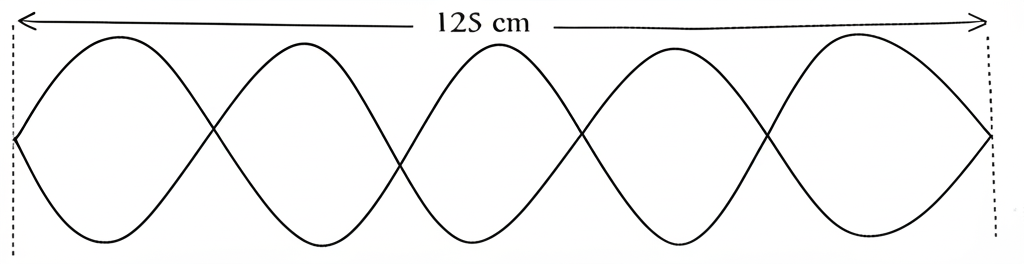
The diagram above illustrates a mode of vibration of a wire of length 125 cm. The speed of the waves along the wire is 120 m s-1. Use the diagram to answer questions 39 and 40
39. The diagram illustrates a mode of vibration of a wire of length 125 cm. The speed of the waves along the wire is 120 m s-1. Determine the wavelength of the waves.
Explanation:
The correct answer is: A
The diagram shows a standing wave with 5 loops, indicating the fifth harmonic (\( n = 5 \)). For a wire fixed at both ends, \( \lambda = \frac{2L}{n} \), where \( L = 1.25 \, \text{m} \):
40. The diagram illustrates a mode of vibration of a wire of length 125 cm. The speed of the waves along the wire is 120 m s-1. Determine the frequency of the waves.
Explanation:
The correct answer is: B
Using the wavelength \( \lambda = 0.50 \, \text{m} \) from Question 39 and the wave speed \( v = 120 \, \text{m/s} \), the frequency is:
41. Which of the following statements about the properties of the electric field produced by charged parallel plates is not correct?
Explanation:
The correct answer is: A
The electric field between parallel plates is mostly uniform, but not everywhere. Near the edges, the field spreads out, which is called edge effect. Because of this, the field cannot be perfectly uniform everywhere between the plates.
Here's why the other answers are incorrect:
B. True — the field strength depends on the amount of charge on the plates.
C. True — more charge means a stronger electric field.
D. True — outside the plates, the electric field is nearly zero except at the edges.
42. A car, \( P \), with a velocity of \( 30\ \mathrm{m\,s^{-1}} \) is travelling in the same direction as a car, \( Q \), with a velocity of \( 20\ \mathrm{m\,s^{-1}} \). What is the velocity of \( P \) relative to \( Q \)?
The correct answer is: C
Topic: Relative Velocity
The velocity of \( P \) relative to \( Q \), denoted \( v_{PQ} \), is given by:
This means car \( P \) is moving at \( 10\ \mathrm{m\,s^{-1}} \) faster than car \( Q \) in the same direction.
43. The range of wavelengths of infrared waves in the electromagnetic spectrum is from \(10^{-3}\ \mathrm{m}\) to \(10^{-6}\ \mathrm{m}\). The wavelength of the radiation is:
The correct answer is: C
Topic: Electromagnetic Spectrum – Infrared Waves
The wavelength of infrared radiation lies within the range:
This means the wavelength is longer than \(10^{-6}\ \mathrm{m}\) and shorter than \(10^{-3}\ \mathrm{m}\).
Therefore, the correct statement is that the wavelength is longer than \(10^{-6}\ \mathrm{m}\).
44. When an electron jumps directly from an orbit of \( n = 4 \) to \( n = 2 \),
Explanation:
The correct answer is: D
When an electron moves from a higher energy level to a lower one, it loses energy.
This lost energy is released as a photon.
Here's why the other answers are incorrect:
A. Incorrect — absorption happens when the electron moves to a higher level.
B. Incorrect — only one photon is emitted in a single jump.
C. Incorrect — electrons do not absorb photons when moving down to a lower level.
45. When a light-weight body and a massive body are acted upon by the same force for the same period of time, the
Explanation:
The correct answer is: D
Both bodies experience the same force for the same time.
This gives them the same impulse (Force × time), which means both gain the same momentum.
Here's why the other answers are incorrect:
A & B. Incorrect — neither body gets more momentum, they gain the same amount.
C. Incorrect — the lighter body gets a higher velocity, but momentum is the same.
46. Which of the following devices is associated with alternating currents only?
Explanation:
The correct answer is: B
A step-up transformer needs a changing magnetic field to work.
Only alternating current (AC) can create this changing magnetic field.
Here's why the other answers are incorrect:
A. Lead-acid accumulator stores DC, not AC.
C. Moving-coil galvanometer measures small DC currents.
D. Induction coil can work with DC when switched but is not AC-only.
47. A body starts with an initial velocity of \( 20 \, \text{m s}^{-1} \) and moves with a uniform acceleration, \( a \), for 15 seconds. Which of the following equations represents the distance, \( S \), travelled?
Explanation:
The correct answer is: B
Topic: Equations of Motion
The equation for distance travelled under uniform acceleration is:
\[
S = ut + \frac{1}{2} a t^2
\]
Given initial velocity \( u = 20 \, \text{m/s} \) and time \( t = 15 \, \text{s} \), substitute:
\[
S = 20 \times 15 + \frac{1}{2} a \times 15^2
\]
Calculate the terms:
\[
S = 300 + \frac{1}{2} a \times 225
\]
Simplify the expression:
\[
S = 300 + \frac{225a}{2}
\]
This matches option B.
48. The ratio of the maximum range to the maximum height of a projectile is 4. Determine the angle of projection.
Explanation:
The correct answer is: B
Topic: Projectile Motion
For a projectile, the maximum range \( R \) and maximum height \( H \) are given by:
\[
R = \frac{u^2 \sin(2\theta)}{g}, \quad H = \frac{u^2 \sin^2\theta}{2g}
\]
49. The following statements are observations made about a towing vehicle and a bus that is being towed.
I. The force exerted on the bus by the towing vehicle is of the same magnitude as the force that the bus exerts on the road.
II. The force exerted on the bus by the towing vehicle is of the same magnitude as the force exerted on the towing vehicle by the bus.
III. The towing vehicle exerts a force on the bus greater than the force exerted by the bus on the towing vehicle.
IV. The towing vehicle exerts a force on the bus that is the same as the force the road exerts on the towing vehicle.
Which of the following statements is/are correct?
Explanation:
The correct answer is: A
According to Newton's Third Law of Motion, every action force has an equal and opposite reaction force.
So the force the towing vehicle exerts on the bus is equal in magnitude and opposite in direction to the force the bus exerts back on the towing vehicle.
This matches statement II.
Here's why the other statements are incorrect:
I. Incorrect — The force the bus exerts on the road is not related to the force between the bus and the towing vehicle.
III. Incorrect — The forces between the bus and the towing vehicle are equal, not greater or smaller.
IV. Incorrect — The force the road exerts on the towing vehicle is a different interaction (road–vehicle), not vehicle–bus.
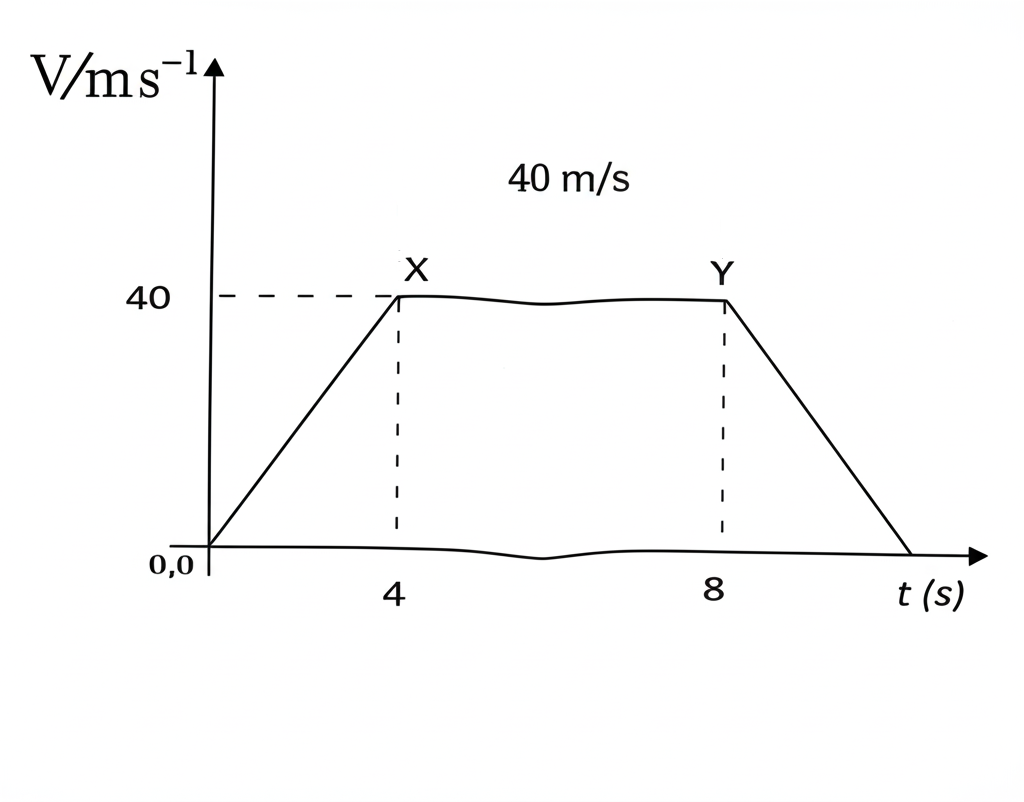
50.
The diagram illustrates a velocity-time graph. Determine the distance between X and Y.
Explanation:
The correct answer is: C
The distance between X and Y is the area under the velocity-time graph from \( t = 4 \, \text{s} \) to \( t = 8 \, \text{s} \). The velocity is constant at 40 m/s, so the area is a rectangle:
Our Mission: To provide free, accessible, and comprehensive exam preparation resources for West African students preparing for their WASSCE and LJHSCE examinations.
Our Story
StudyWASSCE was created in 2023 by an independent content creator who recognized a critical gap in accessible educational resources for West African students. After witnessing countless students struggle to find quality past examination papers and affordable study materials, I dedicated myself to building a comprehensive, completely free platform that would level the playing field for all students, regardless of their economic background.
The Creator Behind StudyWASSCE
As an independent educational content creator, I have invested countless hours researching, compiling, and organizing past examination papers from official sources. My commitment stems from a deep belief that every student deserves access to quality educational resources, regardless of their financial circumstances.
My Journey:
Extensive Research: Spent months collecting and verifying past WASSCE and LJHSCE papers from multiple reliable sources
Quality Assurance: Personally reviewed and cross-checked answers against official marking schemes and educational standards
User-Friendly Design: Developed an intuitive platform that works seamlessly on mobile devices, tablets, and computers
Continuous Improvement: Regularly update content and platform features based on student needs and feedback
What Makes StudyWASSCE Different
Completely Free Access
No Hidden Costs: Absolutely no subscriptions, registration fees, or premium tiers
No Account Required: Instant access to all materials without personal information
Sustainable Model: Supported by ethical advertising to maintain free access
Verified and Reliable Content
Official Sources: All examination papers sourced from legitimate past examinations
Accurate Answers: Solutions verified against official marking schemes
Clear Explanations: Simple, easy-to-understand explanations for complex concepts
Regular Updates: New papers added as they become available
Student-Focused Design
Mobile Optimized: Perfect for studying on phones during commutes or breaks
Organized by Subject: Easy navigation through different subjects and paper types
Instant Feedback: Immediate answers for objective questions
Accessible Language: Content written in clear, understandable English
Our Specialized Focus
Unlike general educational platforms, StudyWASSCE specializes exclusively in:
WASSCE Preparation: Comprehensive coverage of all major WASSCE subjects including Biology, Chemistry, Physics, Mathematics, English Language, Literature, History, Geography, and Economics
LJHSCE Preparation: Complete resources for General Science, Language Arts, Mathematics, and Social Studies
West African Context: Content specifically tailored for the West African educational system and curriculum
Supporting Free Education
How We Stay Free
StudyWASSCE operates on a sustainable model that keeps education free while ensuring quality:
Ethical Advertising: We display relevant, age-appropriate advertisements that support our free service
Google AdSense Partnership: Professional advertising relationships that maintain user experience
Data Analytics: Anonymous usage data helps us improve content and user experience
Community Support: Voluntary contributions from users who appreciate our mission
Our Commitment to Privacy
No Personal Data Collection: We don't require or store personal student information
Transparent Practices: Clear policies about cookies and analytics usage
Student Safety: Age-appropriate content and advertising standards
Impact and Reach
Since launching, StudyWASSCE has:
Provided free access to thousands of students across West Africa
Supported both school-based and private candidates
Helped students from rural and urban areas access quality study materials
Assisted parents and teachers in supporting student preparation
Contributed to improved examination performance in target demographics
Looking Forward
Continuous Development
As an independent creator, I am committed to:
Expanding Content: Adding more subjects and past papers as they become available
Improving Features: Enhancing user experience based on student feedback
Maintaining Quality: Ensuring all content remains accurate and up-to-date
Preserving Free Access: Never compromising on our commitment to free education
Educational Partnerships
We welcome partnerships with:
Educational institutions seeking to support their students
Teachers who want to incorporate our resources in their classrooms
Educational organizations committed to accessible learning
Technology partners who share our vision of free education
Contact the Creator
As the independent creator behind StudyWASSCE, I personally respond to:
Content Feedback: Suggestions for improving explanations or adding new materials
Technical Issues: Problems with site functionality or mobile access
Partnership Inquiries: Collaboration opportunities with educational institutions
Student Support: Questions about using the platform effectively
Response Commitment: I personally review and respond to all messages within 48-72 hours.
A Personal Note
Education transformed my life, and I believe it can transform the lives of every student who has access to quality resources. StudyWASSCE represents my personal commitment to ensuring that no student is left behind due to lack of access to study materials. Every hour I spend improving this platform is an investment in the future of West African education.
Thank You for Your Support! By using StudyWASSCE and viewing our advertisements, you help sustain this free educational resource. Your success is our success, and every student who passes their examinations using our materials validates our mission.
StudyWASSCE: Created by an independent educator, for students everywhere.
Empowering West African students through free, accessible education.
×
Privacy Policy
1. Who We Are
StudyWASSCE is an independent educational platform created to provide free access to past exam papers and study materials for WASSCE and LJHSCE examinations. We are committed to helping students succeed while maintaining transparency about our data practices.
2. Information We Collect
To improve our service and comply with advertising requirements, we collect the following information:
2.1 Automatically Collected Data
Google Analytics: We use Google Analytics to collect anonymous usage statistics including pages visited, time spent on site, user location (country/region level), device type, and browser information
Server Logs: Basic technical information such as IP addresses, access times, and pages requested
Device Information: Browser type, operating system, screen resolution, and language preferences for site optimization
2.2 Cookies and Tracking Technologies
Essential Cookies: Required for basic site functionality
Analytics Cookies: Used by Google Analytics to understand site usage
Advertising Cookies: Used by Google AdSense and other advertising partners to show relevant ads
3. How We Use Your Information
We use collected information to:
Analyze site usage patterns to improve content and user experience
Identify the most valuable study materials for students
Optimize site performance and fix technical issues
Comply with advertising platform requirements
Generate anonymous reports on site performance
4. Advertising and Third-Party Services
Our site is supported by advertising to keep educational content free. We work with the following third-party services:
4.1 Google AdSense
Google AdSense may use cookies and web beacons to serve ads based on your interests
We do not sell or rent personal information. We may share data with:
Google: Through Analytics and AdSense services as described above
Hosting Providers: For technical operations and security
Legal Requirements: When required by law or to protect our rights
6. Consent and Your Choices
Required for Site Access: By using StudyWASSCE, you consent to our data collection practices as described in this policy. This includes:
Essential cookies for site functionality
Analytics data collection for site improvement
Advertising cookies to support our free educational content
Your Options:
Browser Settings: You can disable cookies in your browser, though this may affect site functionality
Ad Personalization: While we require ad display for free access, you can control ad personalization through Google's Ad Settings
Alternative Access: If you cannot accept these terms, we recommend using school computers or libraries that may have different privacy settings
Note: Continued use of our platform indicates your ongoing consent to these practices.
7. Data Security
We implement appropriate technical and organizational security measures to protect the information we collect. However, no internet transmission is completely secure, and we cannot guarantee absolute security.
8. Children's Privacy
Our site is designed for students of all ages. We do not knowingly collect personal information from children under 13 without parental consent. If you believe we have collected such information, please contact us immediately.
9. International Users
Our site is hosted and operated from servers that may be located in different countries. By using our site, you consent to the transfer of your information to these locations.
10. Changes to This Policy
We may update this privacy policy periodically to reflect changes in our practices or legal requirements. We will post any changes on this page with an updated revision date. Continued use of our site after changes constitutes acceptance of the updated policy.
11. Contact Information
If you have any questions about this privacy policy or our data practices, please contact us via WhatsApp at +231-770450825, by email at davidlamine96@gmail.com, or through our Facebook page @Study For WASSCE.
×
Terms of Service
Last Updated: January 15, 2025
Important Notice: By using StudyWASSCE, you agree to these Terms of Service and our Privacy Policy. This site uses cookies and displays advertisements to provide free educational content.
1. About StudyWASSCE
1.1 Who We Are
StudyWASSCE is an independent educational platform created and maintained by a dedicated content creator who has worked extensively to compile and organize past examination papers for WASSCE (West African Senior School Certificate Examination) and LJHSCE (Liberian Junior High School Certificate Examination). Our mission is to provide free access to quality educational resources for students preparing for these national examinations.
1.2 Our Content
All examination papers, questions, and educational materials on this platform have been carefully curated from publicly available past examination papers. We provide:
Past WASSCE examination papers with answers and explanations
Past LJHSCE examination papers with answers and explanations
Study guides and educational resources
Free access to all content without requiring user accounts
2. Acceptance of Terms
By accessing, browsing, or using StudyWASSCE in any way, you acknowledge that you have read, understood, and agree to be bound by these Terms of Service and our Privacy Policy. If you do not agree to these terms, please discontinue use of our platform immediately.
3. Free Educational Service
3.1 No Cost Access
StudyWASSCE provides completely free access to all educational content. You are not required to:
Create an account or provide personal information
Pay any fees or subscriptions
Download any special software
3.2 Revenue Model
To maintain this free service, StudyWASSCE is supported by:
Google AdSense: We display advertisements through Google's advertising network
Other Advertising Partners: We may work with additional reputable advertising networks
Voluntary Support: Users may voluntarily support the platform through donations (when available)
4. Advertising and Cookies Policy
4.1 Advertisement Display
Required for Free Access: Advertisements are essential to maintaining our free educational service. By using StudyWASSCE, you consent to the display of advertisements throughout the platform.
4.2 Google AdSense Compliance
Our advertising practices comply with Google AdSense policies:
Advertisements are clearly labeled and distinguished from educational content
We do not encourage clicking on ads or engage in fraudulent ad practices
Ad placement follows Google's guidelines for user experience
We maintain editorial independence from advertisers
4.3 Cookie Usage
Essential for Site Operation: StudyWASSCE uses cookies for:
Site Functionality: Essential cookies for basic website operations
Analytics: Google Analytics cookies to understand site usage and improve content
Advertising: Cookies used by Google AdSense and other advertising partners to display relevant ads
Performance: Cookies to optimize site speed and user experience
By using our site, you consent to our use of cookies as described in our Privacy Policy.
5. Content Usage and Intellectual Property
5.1 Educational Use License
StudyWASSCE grants you a limited, non-exclusive, non-transferable license to access and use our content for personal educational purposes only. You may:
View and study all available examination papers and materials
Print materials for personal study use
Share links to our platform with other students
5.2 Prohibited Uses
You may NOT:
Commercial Use: Sell, license, or profit from our content
Redistribution: Republish our content on other websites or platforms without written permission
Bulk Download: Use automated tools to download large portions of our content
Copyright Violation: Claim ownership of our compiled materials
Platform Abuse: Use our site in ways that harm functionality or other users' experience
Ad Interference: Block, manipulate, or fraudulently interact with advertisements
5.3 Original Compilation Rights
While individual examination questions may be public domain, our compilation, organization, explanations, and presentation represent original work protected by intellectual property rights.
6. Data Collection and Analytics
6.1 Google Analytics
We use Google Analytics to collect anonymous usage data to improve our educational content and user experience. This includes:
Pages visited and time spent on content
Geographic location (country/region level)
Device and browser information
Traffic sources and navigation patterns
Popular content and study materials
6.2 Purpose of Data Collection
We use this data to:
Identify the most valuable study materials for students
Improve site performance and user experience
Understand which subjects need more content
Optimize content for mobile and desktop users
Generate reports for potential educational partnerships
7. User Responsibilities
7.1 Appropriate Use
Users must:
Use the platform responsibly and ethically
Respect intellectual property rights
Not attempt to circumvent advertising or tracking systems
Report technical issues or inappropriate content
Accept that advertisements are part of the free service model
7.2 Age Requirements
StudyWASSCE is designed for students of all ages. Users under 13 should have parental consent before using our platform, particularly regarding cookie acceptance and data collection.
8. Content Accuracy and Educational Disclaimers
8.1 Best Effort Accuracy
While we strive for accuracy in all educational content:
Answers and explanations are provided to the best of our knowledge
Users should verify information with official sources when possible
We welcome corrections and improvements to our content
Content is regularly reviewed and updated
8.2 Educational Supplement
Important: StudyWASSCE is a study supplement and should not replace formal education, textbooks, or qualified instruction. Users should use our resources alongside official study materials and classroom learning.
9. Platform Availability and Technical Issues
9.1 Service Availability
We strive to maintain consistent platform availability, but cannot guarantee:
100% uptime or uninterrupted access
Compatibility with all devices and browsers
Freedom from technical errors or bugs
Immediate resolution of technical issues
9.2 Maintenance and Updates
We reserve the right to:
Perform scheduled maintenance that may temporarily limit access
Update content, features, and platform functionality
Modify the user interface and user experience
Implement new advertising formats or partners
10. Privacy and Data Protection
10.1 Privacy Commitment
We are committed to protecting user privacy while providing free educational services. Our data collection practices are detailed in our Privacy Policy and comply with:
Google AdSense privacy requirements
Google Analytics terms of service
Applicable data protection regulations
Best practices for educational websites
10.2 Third-Party Services
Our platform integrates with reputable third-party services that have their own privacy policies:
Google AdSense: For advertisement serving
Google Analytics: For usage analytics
Hosting Providers: For platform infrastructure
11. Limitation of Liability
11.1 Educational Use Disclaimer
StudyWASSCE is provided "as is" for educational purposes. We disclaim liability for:
Examination results or academic performance
Decisions made based on our content
Technical issues affecting access to materials
Third-party advertisements or external links
Loss of study time due to platform unavailability
11.2 Maximum Liability
In no event shall StudyWASSCE be liable for any indirect, incidental, special, or consequential damages arising from platform use, even if advised of the possibility of such damages.
12. Compliance and Legal Requirements
12.1 Advertising Standards
Our advertising practices comply with:
Google AdSense Publisher Policies
Local advertising standards and regulations
Educational content guidelines
Age-appropriate advertising requirements
12.2 Copyright Compliance
We respect intellectual property rights and maintain compliance with copyright laws regarding educational fair use of examination materials.
13. Platform Modifications and Updates
13.1 Content Updates
We regularly update our platform with:
New examination papers as they become available
Improved explanations and study materials
Enhanced user interface and functionality
Updated advertising formats and placements
13.2 Terms Modifications
We reserve the right to modify these Terms of Service to:
Comply with changing advertising policies
Reflect new platform features or content
Address legal or regulatory requirements
Improve user experience and service quality
Updated terms will be posted on this page with revision dates. Continued use after changes constitutes acceptance of updated terms.
14. Governing Law and Jurisdiction
These Terms of Service shall be governed by and construed in accordance with the laws of the Republic of Liberia. Any disputes arising from these terms or platform use shall be subject to the jurisdiction of Liberian courts.
15. Severability
If any provision of these Terms of Service is found to be unenforceable or invalid, that provision shall be limited or eliminated to the minimum extent necessary so that the remaining terms remain in full force and effect.
16. Entire Agreement
These Terms of Service, together with our Privacy Policy, constitute the entire agreement between you and StudyWASSCE regarding platform use and supersede all prior agreements or understandings.
17. Contact Information
For questions about these Terms of Service, content issues, or platform feedback, please contact us through:
Response Time: We aim to respond within 48-72 hours
For Urgent Issues: Technical problems affecting site access, inappropriate advertisements, or content errors.
For Partnership Inquiries: Educational institutions, content contributors, or collaboration opportunities.
Thank you for using StudyWASSCE! Your use of our platform helps us continue providing free educational resources to students across West Africa. We appreciate your support through advertisement viewing and ethical use of our content.