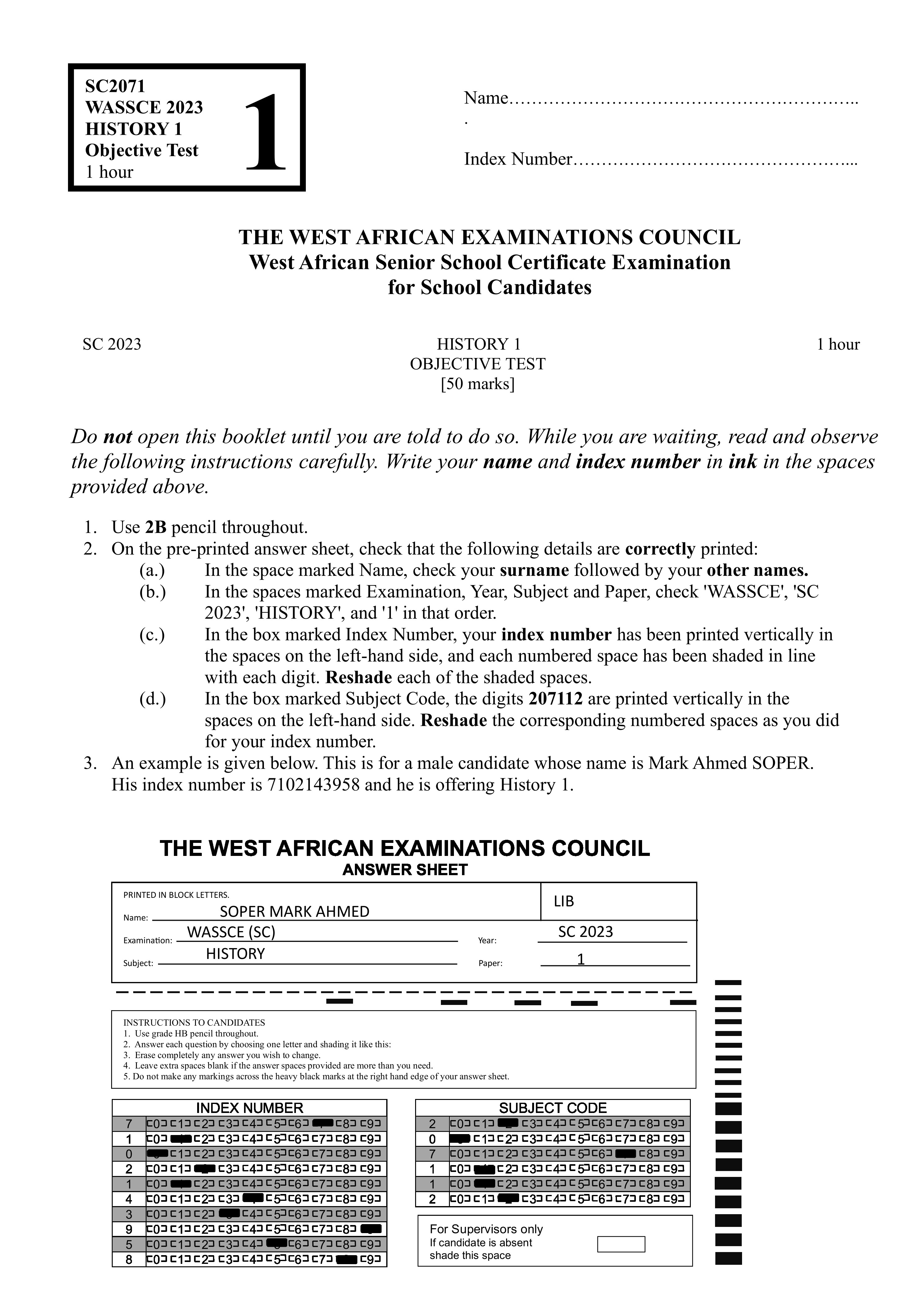
Answer all the questions
Each question is followed by four options lettered A to D. Find the correct option for each question and shade in pencil on your answer sheet, the answer space which bears the same letter as the option you have chosen. Give only one answer to each question. An example is given below.
Knowledge of the use of iron enabled the early man in West Africa to
A. learn the practice of agriculture.
B. control his environment more effectively.
C. acquire the knowledge of warfare.
D. develop a religious culture.
The correct answer is control his environment more effectively, which is lettered B, and therefore answer space B would be shaded.


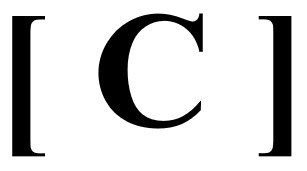

Think carefully before you shade the answer space; erase completely any answer(s) you wish to change.
Now answer the following questions:
Explanation:
The correct answer is:
D. Patriotic
Topic: Civics
The study of a nation's history helps its people feel proud and connected to their country. This makes them more likely to support their nation and work towards its growth and unity.
Here's why the other answers are wrong:
Explanation:
The correct answer is:
C. Archaeological evidence
Topic: Sources of History
Archaeological evidence is information we get from things like old tools, pottery, and buildings. These things help us understand how people lived in the past.
Here's why the other answers are wrong:
Explanation:
The correct answer is:
D. Diaries
Topic: Sources of History
Diaries are written records from people. Since they are written, they are considered documentary sources of history, unlike other non-documentary sources like archaeology or numismatics.
Here's why the other answers are wrong:
Explanation:
The correct answer is:
B. Inaccurate dating
Topic: Limitations of Archaeology
Inaccurate dating is a big problem in archaeology. It's important to know when an artefact was used, but sometimes the methods used to find the exact date, like carbon dating, can be unclear or wrong.
Here's why the other answers are wrong:
Explanation:
The correct answer is:
A. Caravan trade
Topic: Trans-Saharan Slave Trade
The trans-Saharan trade is also called the caravan trade because traders used groups of camels, called caravans, to travel across the Sahara Desert. They carried goods like gold, salt, and slaves between Africa and other regions.
Here's why the other answers are wrong:
Explanation:
The correct answer is:
B. Swahili
Topic: Trans-Saharan Slave Trade
The Swahili people lived along the East African coast and traded mainly across the Indian Ocean. They were not part of the trans-Saharan trade, which took place across the Sahara Desert. The other groups (Berbers, Tuareg, and Hausa) were involved in the trans-Saharan trade.
Here's why the other answers are wrong:
Explanation:
The correct answer is:
C. Taghaza and Bilma
Topic: Trans-Saharan Trade
Taghaza and Bilma were the main places where salt was found in large amounts. Salt was very important for trade, especially for preserving food, and these places were key in providing it for trade across the Sahara.
Here's why the other answers are wrong:
Explanation:
The correct answer is:
A. size of the caravan and weather condition
Topic: Trans-Saharan Trade
The time it took for traders to cross the Sahara depended on how big their caravan was and the weather. Big caravans with many camels would take longer to travel, and bad weather could slow them down too.
Here's why the other answers are wrong:
Explanation:
The correct answer is:
B. Indian Ocean
Topic: Trans-Saharan Trade
Cowrie shells were used as money in the trans-Saharan trade. They were mainly collected from the coast of the Indian Ocean, especially along the East African coast, where they were common and valuable for trading.
Here's why the other answers are wrong:
Explanation:
The correct answer is:
D. trans-Saharan trade
Topic: Spread of Islam in West Africa
Islam spread to West Africa mainly through trade across the Sahara Desert. Muslim traders and merchants brought Islam to the region, especially to cities like Timbuktu and Gao, long before large invasions or wars occurred.
Here's why the other answers are wrong:
Explanation:
The correct answer is:
B. had enormous power and influence over their people
Topic: Spread of Islam in West Africa
Muslim scholars targeted the rulers because they had a lot of power. If the rulers converted to Islam, their people were more likely to follow. By converting the leaders, they could spread Islam to a larger group of people.
Here's why the other answers are wrong:
Explanation:
The correct answer is:
A. Jenne and Timbuktu
Topic: Islamic Education in West Africa
Jenne and Timbuktu were well-known centers of Islamic learning. Scholars from different parts of the Muslim world visited these cities between the 13th and 15th centuries to study subjects like religion, science, law, and philosophy.
Here's why the other answers are wrong:
Explanation:
The correct answer is:
D. the number of wives and children they had
Topic: Influence of Muslim Scholars in West Africa
Muslim scholars became influential in royal courts because of their knowledge of Arabic, Islamic law, and religious training. Having many wives or children did not contribute to their influence in the courts.
Here's why the other answers are wrong:
Explanation:
The correct answer is:
A. Complete abolition of traditional religions
Topic: Effects of Islam in West Africa
Islam did not completely replace traditional religions. In many areas, Islam coexisted with older beliefs and practices, blending together over time.
Here's why the other answers are wrong:
Explanation:
The correct answer is:
C. Portuguese
Topic: European Exploration in West Africa
The Portuguese were the first Europeans to explore West Africa, starting in the 15th century. They set up trading posts along the coast, helping to open the way for more European explorers.
Here's why the other answers are wrong:
Explanation:
The correct answer is:
D
Topic: European Expansion in West Africa
Europeans came to West Africa in the 15th century mainly for trade, exploration, and the introduction of Christianity. The establishment of factories (trading posts) became important later, but it was not the initial reason for European exploration in the region.
Here's a breakdown:
Explanation:
The correct answer is:
B. wanted to maintain their middleman position in the trade.
Topic: Resistance to European Penetration
West Africans opposed European penetration into the interior to protect their control over the trade routes. They were the middlemen between the Europeans and the inner parts of Africa, and they feared losing their important position if the Europeans gained direct access to the interior.
Here's why the other answers are wrong:
Explanation:
The correct answer is:
A. emergence of the Mulatto race.
Topic: Social Impact of European Contact
Early European contact with West Africa led to the emergence of the Mulatto race. This was due to intermarriage between Europeans and Africans, which created a mixed-race population in areas where trade and settlement took place.
Here's why the other answers are wrong:
Explanation:
The correct answer is:
C. grains.
Topic: European Trade with West Africa
Early Europeans traded goods like guns, copper, and mirrors with West Africans. However, grains were not typically part of the European trade in West Africa. Europeans mostly traded manufactured goods in exchange for gold, ivory, and slaves.
Here's why the other answers are wrong:
Explanation:
The correct answer is:
D. introduction of firearms in West Africa.
Topic: Factors Affecting the Slave Trade
The introduction of firearms in West Africa may have led to more violence, but it was not a direct factor in increasing the trans-Atlantic slave trade. The main factors contributing to the increase in the slave trade were the Industrial Revolution, the invention of the steamship, and the high demand for cheap labor in the New World.
Here's why the other answers are wrong:
Explanation:
The correct answer is:
C. use them in their plantations and mines.
Topic: Reasons for the Trans-Atlantic Slave Trade
Europeans took slaves from West Africa to use them in plantations and mines in the Americas and the Caribbean, where there was a strong need for labor to produce crops like sugar, tobacco, and cotton. This was a main reason for the expansion of the trans-Atlantic slave trade.
Here's why the other answers are wrong:
Explanation:
The correct answer is:
B. Cotton
Topic: Trans-Atlantic Slave Trade Commodities
Cotton was not directly involved in the trans-Atlantic slave trade. The key items traded were firearms, slaves, and other goods like salt and textiles that supported the system of trade and helped to sustain the economy of the slave trade.
Here's why the other answers are wrong:
Explanation:
The correct answer is:
B. it had become their main source of revenue.
Topic: Challenges to Stopping the Slave Trade
The West African chiefs found it difficult to stop the trans-Atlantic slave trade because it had become an important source of income for their kingdoms. The trade provided economic benefits, which made it hard for them to oppose or end it despite its harmful effects.
Here's why the other answers are wrong:
Explanation:
The correct answer is:
A. stationing armed soldiers all over West Africa.
Topic: Britain's Measures to Suppress the Slave Trade
Britain did not station armed soldiers all over West Africa to suppress the trans-Atlantic slave trade. Instead, their efforts focused on encouraging legitimate trade, supporting the work of Christian missionaries, and establishing a Naval Squadron along the West African coast to enforce anti-slavery laws.
Here's why the other answers are wrong:
Explanation:
The correct answer is:
C. Portugal
Topic: Introduction of Christianity to West Africa
Christianity was first introduced to West Africans by Portuguese missionaries. Portugal played a significant role in spreading Christianity during the early period of European contact with West Africa.
Here's why the other answers are wrong:
Explanation:
The correct answer is:
B. built markets for the poor people.
Topic: Christian Missionaries in West Africa
Christian missionaries focused on spreading the gospel, providing social services like education and healthcare, and supporting the suppression of the slave trade. However, they did not build markets for the poor people as part of their mission.
Here's why the other answers are wrong:
Explanation:
The correct answer is:
D. Church Missionary Society
Topic: Missionary Organizations in Sierra Leone
The Church Missionary Society (CMS) was the first missionary organization to establish a strong presence in Sierra Leone. It played a key role in spreading Christianity and education in the region.
Here's why the other answers are wrong:
Explanation:
The correct answer is:
A. overcrowding in churches.
Topic: Missionaries in West Africa
Missionaries faced many challenges, such as the spread of diseases like malaria and yellow fever, harsh climates, and a lack of volunteers. However, overcrowding in churches was not a significant problem that hampered their work in the region.
Here's why the other answers are wrong:
Explanation:
The correct answer is:
B. Christianity with agriculture.
Topic: The "Bible and Plough" Policy
The "Bible and plough" policy meant that missionaries wanted to teach people both farming and Christianity. They thought that learning how to farm while learning about religion would help people grow in both their faith and their way of life.
Here’s why the other answers are wrong:
Explanation:
The correct answer is:
C
Topic: Causes of the Scramble for African Territories
The Industrial Revolution in Europe made countries want more raw materials like rubber, gold, and oil. They needed these materials to keep their factories working. So, they started to take land in Africa to get these resources.
Why the other answers are wrong:
Explanation:
The correct answer is:
B
Topic: Berlin Conference, 1884-85
The Berlin Conference in 1884-85 was held in Berlin, Germany. European countries met there to divide Africa and decide who would control which parts. This was done to avoid fighting among European countries over African land.
Why the other answers are wrong:
Explanation:
The correct answer is:
D
Topic: European Colonial Acquisition in West Africa
France took control of a large part of West Africa. They controlled countries like Mali, Niger, Senegal, and Burkina Faso. France expanded a lot during the Scramble for Africa, and they got the most land in this region.
Why the other answers are wrong:
Explanation:
The correct answer is:
C. European merchants and missionaries
Topic: Pressures for the Scramble for Africa
European merchants wanted new sources of raw materials, while missionaries wanted to spread Christianity. These pressures led European countries to scramble for control of African land and resources.
Here's why the other answers are wrong:
Explanation:
The correct answer is:
A. Colonial rule
Topic: Impact of the Scramble for Africa
The partition of West Africa led to the establishment of colonial rule. European powers took control of African territories, either directly or as protectorates. This changed the political, social, and economic systems in the region.
Here's why the other answers are wrong:
Explanation:
The correct answer is:
B. Western Europe
Topic: Colonial Powers in West Africa
All the colonial powers involved in the scramble for West Africa, including Britain, France, Portugal, and Germany, were from Western Europe. These countries fought for control of African territories during the late 19th and early 20th centuries.
Here's why the other answers are wrong:
Explanation:
The correct answer is:
D. Indirect Rule
Topic: Colonial Administration in West Africa
Indirect Rule allowed African leaders to keep some power over their people while being controlled by the British. This system let some African traditions and ways of life continue, even under colonial rule.
Here's why the other answers are wrong:
Explanation:
The correct answer is:
A. France and Portugal
Topic: European Colonization in West Africa
France and Portugal treated their colonies as parts of their own countries. They didn't just rule them from a distance, but they were seen as overseas provinces. This was different from Britain, who treated their colonies as separate areas with their own systems.
Here's why the other answers are wrong:
Explanation:
The correct answer is:
B. Indirect Rule
Topic: British Colonial Administration
The British used Indirect Rule in their colonies in West Africa. This meant that they let African leaders keep some of their powers but still controlled the colony from behind the scenes. This system was cheaper for the British and helped keep order in the colonies.
Here's why the other answers are wrong:
Explanation:
The correct answer is:
C. Increase in political awareness
Topic: Impact of World War II on West Africa
World War II made people in West Africa more aware of their rights and the possibility of gaining independence. The war showed the problems with colonial rule and helped spark movements for self-rule in the region.
Here's why the other answers are wrong:
Explanation:
The correct answer is:
D. Great respect for traditional institutions
Topic: Factors Behind West African Nationalism
While people in West Africa respected their traditional institutions, this was not a main reason for fighting against colonial rule. The nationalists were more upset about things like discrimination, the unfair way resources were taken, and bad laws made by the colonial powers.
Here's why the other answers are wrong:
Explanation:
The correct answer is:
A. Proliferation of political parties
Topic: Political Problems in West Africa
Having many political parties was not a big problem. On the other hand, foreign countries interfering in politics, unstable governments, and unfair elections were much bigger issues in West Africa.
Here's why the other answers are wrong:
Explanation:
The correct answer is:
C. Togo
Topic: Military Takeovers in West Africa
The first military coup in an independent West African country took place in Togo on January 13, 1963. Togolese soldiers overthrew the government and assassinated President Sylvanus Olympio, just three years after Togo gained independence in 1960.
Here's why the other answers are wrong:
Explanation:
The correct answer is:
D. Quick implementation of decisions
Topic: Military Regimes in West Africa
Military regimes in West Africa were often able to succeed because they could make and act on decisions very quickly. They did not have to go through the slow process of debates or approval like democratic governments. This speed gave them the appearance of efficiency, even though their rule often came with negative consequences.
Here's why the other answers are wrong:
Explanation:
The correct answer is:
B. Mismanaged resources of the states
Topic: Negative Effects of Military Rule
Military rule often led to bad management of a country’s resources. Leaders took money and goods for themselves, and this caused problems in the economy. It made things harder for people and stopped countries from growing.
Here's why the other answers are wrong:
Explanation:
The correct answer is:
A. Bad governance
Topic: Underdevelopment in West Africa
Bad governance, like corruption, poor decisions, and leaders not being responsible for their actions, was a big reason why West African countries did not develop well. This stopped the economy from growing even though the region had a lot of potential.
Here's why the other answers are wrong:
Explanation:
The correct answer is:
C. Promotion of indigenous culture
Topic: Problems in Post-Independence West Africa
After independence, West African countries had problems like military takeovers, corruption, and bad leaders. But they also worked on promoting their own cultures and traditions. This was actually a good thing because they wanted to strengthen their identity after colonial rule.
Here's why the other answers are wrong:
Explanation:
The correct answer is:
D. Equality of all men and the right to self-determination
Topic: Atlantic Charter
The Atlantic Charter, signed in 1941, focused on the equality of all people and the right of nations to choose their own form of government. It was an important step in the push for decolonization and for a world where all nations have equal rights.
Here's why the other answers are wrong:
Explanation:
The correct answer is:
B. Promote free movement of people, goods and services
Topic: ECOWAS
ECOWAS was mainly formed to encourage economic cooperation and integration in West Africa. One of its key goals is to allow the free movement of people, goods, and services across member states, which helps to boost regional trade and development.
Here's why the other answers are wrong:
Explanation:
The correct answer is:
A. Maintain global peace
Topic: United Nations
The United Nations (UN) was created in 1945 to help maintain peace around the world. It aims to prevent wars, resolve conflicts, and promote diplomacy between nations to ensure global stability.
Here's why the other answers are wrong:
Explanation:
The correct answer is:
D. It had no high command structure to implement its policies
Topic: Challenges of the OAU
The OAU had trouble reaching its goals because it didn’t have a strong system to make and carry out decisions. Without a central body to lead, it was hard for the OAU to solve problems or take action when needed.
Here's why the other answers are wrong:
Our Mission: To provide free, accessible, and comprehensive exam preparation resources for West African students preparing for their WASSCE and LJHSCE examinations.
StudyWASSCE was created in 2023 by an independent content creator who recognized a critical gap in accessible educational resources for West African students. After witnessing countless students struggle to find quality past examination papers and affordable study materials, I dedicated myself to building a comprehensive, completely free platform that would level the playing field for all students, regardless of their economic background.
As an independent educational content creator, I have invested countless hours researching, compiling, and organizing past examination papers from official sources. My commitment stems from a deep belief that every student deserves access to quality educational resources, regardless of their financial circumstances.
Unlike general educational platforms, StudyWASSCE specializes exclusively in:
StudyWASSCE operates on a sustainable model that keeps education free while ensuring quality:
Since launching, StudyWASSCE has:
As an independent creator, I am committed to:
We welcome partnerships with:
As the independent creator behind StudyWASSCE, I personally respond to:
Response Commitment: I personally review and respond to all messages within 48-72 hours.
Education transformed my life, and I believe it can transform the lives of every student who has access to quality resources. StudyWASSCE represents my personal commitment to ensuring that no student is left behind due to lack of access to study materials. Every hour I spend improving this platform is an investment in the future of West African education.
Thank You for Your Support! By using StudyWASSCE and viewing our advertisements, you help sustain this free educational resource. Your success is our success, and every student who passes their examinations using our materials validates our mission.
StudyWASSCE: Created by an independent educator, for students everywhere.
Empowering West African students through free, accessible education.
StudyWASSCE is an independent educational platform created to provide free access to past exam papers and study materials for WASSCE and LJHSCE examinations. We are committed to helping students succeed while maintaining transparency about our data practices.
To improve our service and comply with advertising requirements, we collect the following information:
We use collected information to:
Our site is supported by advertising to keep educational content free. We work with the following third-party services:
We do not sell or rent personal information. We may share data with:
Required for Site Access: By using StudyWASSCE, you consent to our data collection practices as described in this policy. This includes:
Your Options:
Note: Continued use of our platform indicates your ongoing consent to these practices.
We implement appropriate technical and organizational security measures to protect the information we collect. However, no internet transmission is completely secure, and we cannot guarantee absolute security.
Our site is designed for students of all ages. We do not knowingly collect personal information from children under 13 without parental consent. If you believe we have collected such information, please contact us immediately.
Our site is hosted and operated from servers that may be located in different countries. By using our site, you consent to the transfer of your information to these locations.
We may update this privacy policy periodically to reflect changes in our practices or legal requirements. We will post any changes on this page with an updated revision date. Continued use of our site after changes constitutes acceptance of the updated policy.
If you have any questions about this privacy policy or our data practices, please contact us via WhatsApp at +231-770450825, by email at davidlamine96@gmail.com, or through our Facebook page @Study For WASSCE.
Last Updated: January 15, 2025
Important Notice: By using StudyWASSCE, you agree to these Terms of Service and our Privacy Policy. This site uses cookies and displays advertisements to provide free educational content.
StudyWASSCE is an independent educational platform created and maintained by a dedicated content creator who has worked extensively to compile and organize past examination papers for WASSCE (West African Senior School Certificate Examination) and LJHSCE (Liberian Junior High School Certificate Examination). Our mission is to provide free access to quality educational resources for students preparing for these national examinations.
All examination papers, questions, and educational materials on this platform have been carefully curated from publicly available past examination papers. We provide:
By accessing, browsing, or using StudyWASSCE in any way, you acknowledge that you have read, understood, and agree to be bound by these Terms of Service and our Privacy Policy. If you do not agree to these terms, please discontinue use of our platform immediately.
StudyWASSCE provides completely free access to all educational content. You are not required to:
To maintain this free service, StudyWASSCE is supported by:
Required for Free Access: Advertisements are essential to maintaining our free educational service. By using StudyWASSCE, you consent to the display of advertisements throughout the platform.
Our advertising practices comply with Google AdSense policies:
Essential for Site Operation: StudyWASSCE uses cookies for:
By using our site, you consent to our use of cookies as described in our Privacy Policy.
StudyWASSCE grants you a limited, non-exclusive, non-transferable license to access and use our content for personal educational purposes only. You may:
You may NOT:
While individual examination questions may be public domain, our compilation, organization, explanations, and presentation represent original work protected by intellectual property rights.
We use Google Analytics to collect anonymous usage data to improve our educational content and user experience. This includes:
We use this data to:
Users must:
StudyWASSCE is designed for students of all ages. Users under 13 should have parental consent before using our platform, particularly regarding cookie acceptance and data collection.
While we strive for accuracy in all educational content:
Important: StudyWASSCE is a study supplement and should not replace formal education, textbooks, or qualified instruction. Users should use our resources alongside official study materials and classroom learning.
We strive to maintain consistent platform availability, but cannot guarantee:
We reserve the right to:
We are committed to protecting user privacy while providing free educational services. Our data collection practices are detailed in our Privacy Policy and comply with:
Our platform integrates with reputable third-party services that have their own privacy policies:
StudyWASSCE is provided "as is" for educational purposes. We disclaim liability for:
In no event shall StudyWASSCE be liable for any indirect, incidental, special, or consequential damages arising from platform use, even if advised of the possibility of such damages.
Our advertising practices comply with:
We respect intellectual property rights and maintain compliance with copyright laws regarding educational fair use of examination materials.
We regularly update our platform with:
We reserve the right to modify these Terms of Service to:
Updated terms will be posted on this page with revision dates. Continued use after changes constitutes acceptance of updated terms.
These Terms of Service shall be governed by and construed in accordance with the laws of the Republic of Liberia. Any disputes arising from these terms or platform use shall be subject to the jurisdiction of Liberian courts.
If any provision of these Terms of Service is found to be unenforceable or invalid, that provision shall be limited or eliminated to the minimum extent necessary so that the remaining terms remain in full force and effect.
These Terms of Service, together with our Privacy Policy, constitute the entire agreement between you and StudyWASSCE regarding platform use and supersede all prior agreements or understandings.
For questions about these Terms of Service, content issues, or platform feedback, please contact us through:
For Urgent Issues: Technical problems affecting site access, inappropriate advertisements, or content errors.
For Partnership Inquiries: Educational institutions, content contributors, or collaboration opportunities.
Thank you for using StudyWASSCE! Your use of our platform helps us continue providing free educational resources to students across West Africa. We appreciate your support through advertisement viewing and ethical use of our content.
© 2025 StudyWASSCE. All rights reserved.
Supporting West African education through free access to quality study materials.