[PAPER 2]
Essay
[60 marks]
Answer eight questions in all: five questions from Part I and three questions from Part II.
PART I
[15 marks]
Answer any five questions from this part.
All questions carry equal marks.

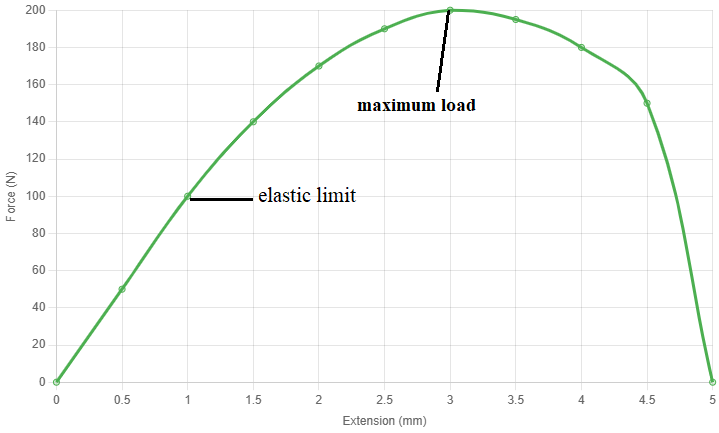
1. A thin aluminium wire is gradually stretched until it breaks. Sketch a force-extension graph for the wire and on the graph indicate the:
(a) Elastic limit;
(b) Maximum load.
[4 marks]
2. (a) State one disadvantage of fibre optic cables as compared to copper cables in the telecommunication industry.
(b) Name two applications of fibre optics in the medical field.
[3 marks]
3. (a) What are ferromagnetic materials?
(b) Name two elements in the periodic table that are ferromagnetic.
[3 marks]
4. The mutual force, F, between two bodies, their distance apart, r, and the product of their masses, m, are related to the universal gravitational constant, G, by the formula:
$$F = \frac{Gm}{r^2}$$
Show that the formula is dimensionally correct.
[3 marks]
5. State the effect of each of the following factors on the rate of diffusion of a fluid:
(a) Temperature;
(b) Concentration gradient;
(c) Density of the fluid.
[3 marks]
6. (a) What is a projectile?
(b) What is a trajectory?
[3 marks]
7. (a) Explain the wave-particle duality of matter.
(b) Name one phenomenon that demonstrates that light behaves as a:
(i) wave;
(ii) particle.
[3 marks]
PART II
[45 marks]
Answer three questions from this part.
All questions carry equal marks
8. (a) State three characteristics of an elastic collision.
[3 marks]
(b) An object of mass 2 kg moving with a speed, u, collided with a stationary box. After collision, the object continued in its original direction with one-quarter of its initial speed. If the total kinetic energy of the colliding system remains constant, calculate the mass of the box.
[5 marks]
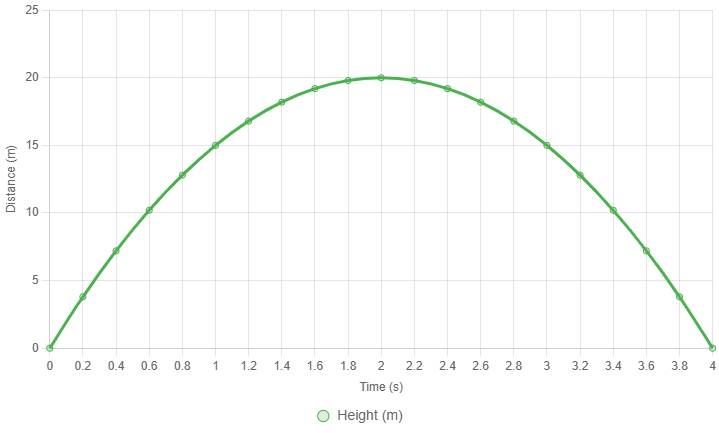
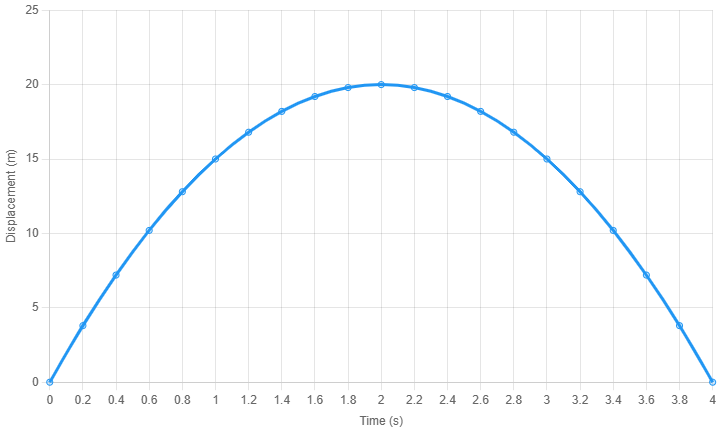
(c) A ball thrown vertically upwards to a height, h, is allowed to fall to the point of projection.
Sketch a:
(i) distance-time graph for the motion;
(ii) displacement-time graph for the motion.
[4 marks]
(d) (i) State two differences between distance and displacement.
(ii) For a given direction, state the relationship between distance and displacement.
[3 marks]
8. (a) Three characteristics of an elastic collision:
1. Total kinetic energy is conserved.
2. Total momentum is conserved.
3. No permanent deformation or heat generation occurs.
8. (b) Conservation of kinetic energy:
\[ \frac{Gm}{r^2} \Rightarrow [G][m][r^{-2}] \]
\[ = \left( M^{-1}L^3T^{-2} \right)\left( M \right)\left( L^{-2} \right) \]
\[ = MLT^{-2} \]
Simplify and solve to find: \[ m_2 = \frac{15}{16} m_1 = \frac{15}{8} \text{ kg} = \mathbf{1.875 \text{ kg}} \]
(c)(i) Distance-Time Graph
(c) (ii) Displacement-Time Graph
(d) Differences between distance and displacement:
(i)
1. Distance is a scalar quantity; displacement is a vector quantity.
2. Distance is the total path covered; displacement is the shortest path in a straight line from start to end.
(ii) For motion in a straight line and in one direction, displacement = distance.
9. (a) State three factors that affect the rate of evaporation.
[3 marks]
(b) A heating coil of resistance, 30 Ω is connected to a 230 V supply for 3 minutes to boil a quantity of water in a container of thermal capacity 150 J K-1. The initial temperature of the water is 50 °C and its specific heat capacity is 4.2 kJ kg-1 K-1. Calculate the quantity of water in the container.
[4 marks]
(c) An insulating vessel contains 80 g of a block of ice at -12 °C. If 450 g of water at 60 °C is added to the ice in the vessel:
(i) Determine whether or not the ice will melt completely;
(ii) Calculate the final temperature of the system.
Given: Specific heat capacity of ice = 2100 J kg-1 K-1,
Latent heat of fusion of ice = 3.33 × 10⁵ J kg-1,
Specific heat capacity of water = 4200 J kg-1 K-1
[6 marks]
(d) State two differences between heat transfer by conduction and by convection.
[2 marks]
10. (a) Explain briefly how stationary waves are formed.
[2 marks]
(b) A standing wave formed between two points separated by a distance of 6 m is represented by the equation:
\[ y = 0.06 \cos\left(\frac{2\pi x}{3}\right) \sin(100\pi t) \]
where \(x\) and \(y\) are in metres and \(t\) is in seconds.
Determine the:
(i) amplitude of the travelling waves;
(ii) speed of the travelling waves;
(iii) number of loops, \(n\), formed between the two points.
[8 marks]
(c) A transparent liquid of refractive index 1.57 is poured into a vessel to a depth of 5 cm. On top of the liquid is a layer of alcohol 10 cm deep. If the refractive index of alcohol is 1.45, determine the apparent displacement of the base of the vessel, when an observer is looking perpendicularly at the surface of the liquid.
[4 marks]
(d) Name one electromagnetic wave that is widely used in medical diagnostics.
[1 mark]
11. (a) (i) What is an electrical circuit?
(ii) List four basic components of any electrical circuit giving an example of each.
[6 marks]
(b)
(i) Define the term relative permittivity.
(ii) A parallel plate capacitor of area \(5.0 \times 10^{-2} \, \text{m}^2\) has a plate separation of 2 mm in air. If a material of thickness 1.5 mm and relative permittivity 4.0 fills the gap between the plates, calculate the capacitance of the capacitor.
\[\varepsilon_0 = 8.9 \times 10^{-12} \, \text{F m}^{-1}\]
[6 marks]
(c) In a metre bridge experiment, a student was unable to find the balance point. Give two reasons for the occurrence.
[2 marks]
(d) State one use of the metre bridge circuit.
[1 mark]
12. (a) Distinguish between \(\beta\) and \(\gamma\) radiations under the following headings:
(i) Nature;
(ii) Charge;
(iii) Speed;
[3 marks]
(b) State two:
(i) Similarities;
(ii) Differences;
between photoelectrons and thermoelectrons.
[4 marks]
(c) A metal, X has a work function of 2.0 eV.
(i) Explain the underlined statement.
(ii) If X is illuminated with light of wavelength \(4.5 \times 10^{-7} \, \text{m}\), calculate the:
(A) Cut-off wavelength;
(β) Maximum energy of the liberated electrons;
(γ) Stopping potential.
[\(h = 6.6 \times 10^{-34} \, \text{Js}\), \(c = 3.0 \times 10^8 \, \text{ms}^{-1}\), \(1 \, \text{eV} = 1.6 \times 10^{-19} \, \text{J}\), \(e = 1.6 \times 10^{-19} \, \text{C}\)]
[8 marks]