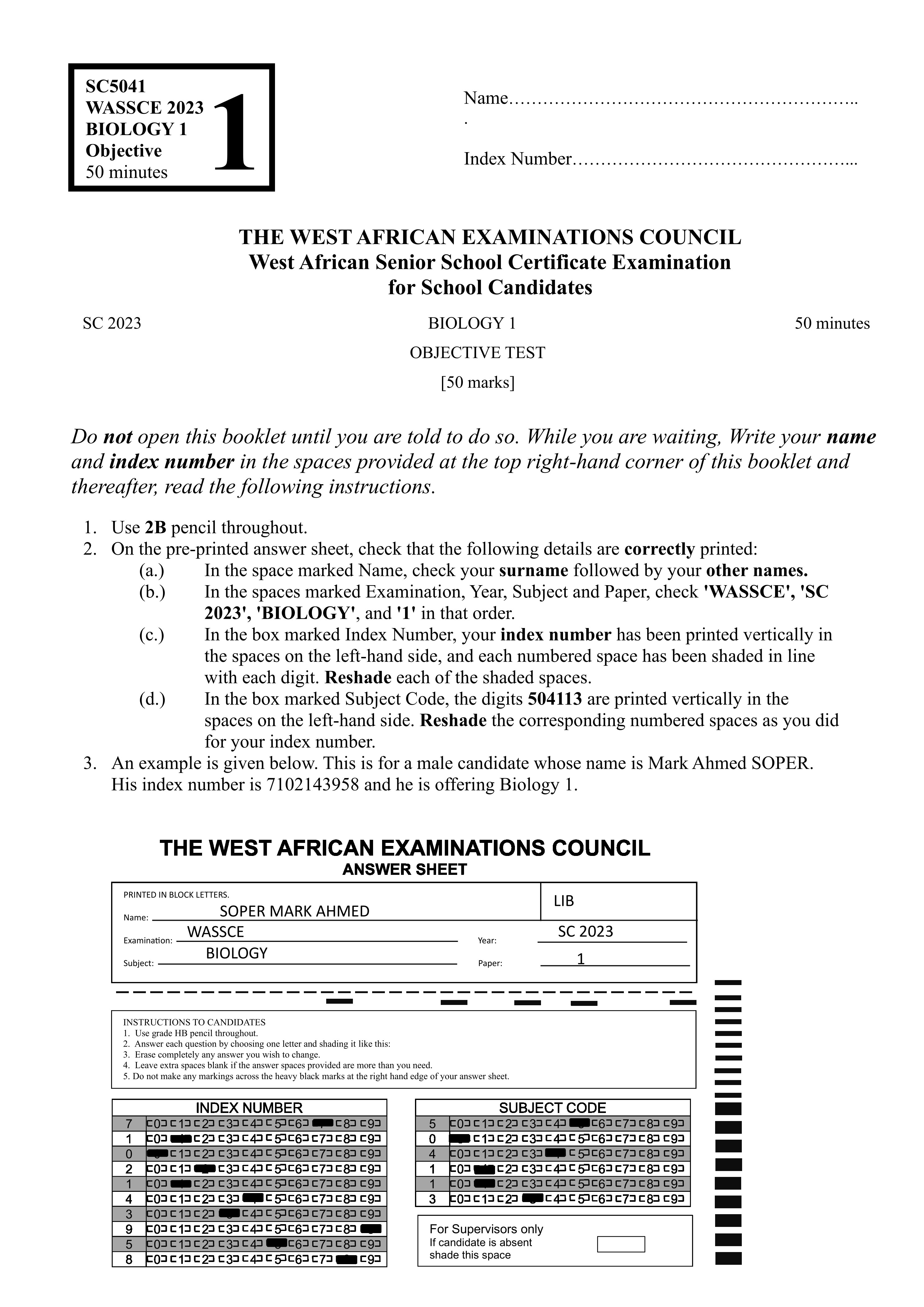
Answer all the questions
Each question is followed by four options lettered A to D. Find the correct option for each question and shade in pencil on your answer sheet, the answer space which bears the same letter as the option you have chosen. Give only one answer to each question. An example is given below.
Which part of the gill of fish is involved in gaseous exchange? Gill
A. slits
B. bars
C. covers
D. filaments
The correct answer is filaments, which is lettered D and therefore answer space D would be shaded.
Think carefully before you shade the answer spaces; erase completely any answer(s) you wish to change.
Do all rough work on this question paper.
Now answer the following questions.
Explanation:
The correct answer is: C. Homeostasis
Homeostasis means the ability of an organism to keep its internal conditions stable, even when the outside environment changes.
Here's why the other answers are incorrect:
Explanation:
The correct answer is: C. Maize
Maize (corn) has parallel venation in its leaves. This is a feature of monocot plants. In parallel venation, the veins run in straight, parallel lines. Other plants like Mango, Groundnut, and Beans have a branching vein pattern known as reticulate venation, which is found in dicot plants.
Here's why the other answers are incorrect:
Explanation:
The correct answer is: D. Magnification
Magnification is the ratio of the drawn size (or image size) to the actual size of an object. It is used to show how much larger an object appears compared to its real size. This term is commonly used in microscopes and other instruments to measure how much an object is enlarged.
Here's why the other answers are incorrect:
Explanation:
The correct answer is: C. Bacteria
Bacteria can be shaped like spheres or balls, which are called "cocci." Bacteria can have different shapes, but cocci is one of the most common. Fungi, viruses, and protozoa do not have this ball shape.
Why the other answers are wrong:
Explanation:
The correct answer is: A. Bacterium
The organism that causes cholera is a bacterium called Vibrio cholerae. It attacks the stomach and intestines, causing severe diarrhea. This leads to dehydration, which can be deadly without treatment.
Why the other answers are incorrect:
Study the list of organisms below and use them to answer questions 6 and 7.
I – Hydra
II – Owl
III – Snake
IV – Snail
Explanation:
The correct answer is: D. I – II – III – IV
When we look at the complexity of these organisms, Hydra (I) is the simplest because it is a small, simple animal. Then, the Owl (II) comes next, followed by the Snake (III). Finally, the Snail (IV) is the most complex because it has more advanced features, like a brain and a more developed nervous system.
Why the other answers are wrong:
Explanation:
The correct answer is: D. Mollusca
The organism labelled as IV, which is a snail, belongs to the Phylum Mollusca. Mollusks are soft-bodied animals, and many of them have shells. Snails, clams, and octopuses are examples of mollusks.
Why the other answers are wrong:
Use the information below to answer questions 8 and 9.
I – vacuole
II – nucleus
III – cell wall
IV – chloroplast
Explanation:
The correct answer is: A. IV
In the chloroplast (IV), sunlight, water, and carbon dioxide come together during the process called photosynthesis. This process produces sugar (glucose) and oxygen. The chloroplast is the part of the cell that makes food for the plant.
Why the other answers are incorrect:
Explanation:
The correct answer is: A. IV
The oxygen gas produced during photosynthesis in the chloroplast (IV) moves out of the plant cell and enters the air through small openings called stomata (found in the leaves). These stomata allow gases like oxygen and carbon dioxide to move in and out of the plant.
Why the other answers are incorrect:
Explanation:
The correct answer is: D. Movement of water from root hairs into cortical cell.
Osmosis is when water moves from an area with fewer water molecules (lower concentration) to an area with more water molecules (higher concentration) through a semipermeable membrane. In plants, water moves from the root hairs (where there is a higher concentration of water) into the cortical cells (where there is a lower concentration of water). This is a clear example of osmosis.
Why the other answers are incorrect:
Explanation:
The correct answer is: D. Plants grow indefinitely.
Unlike animals, which stop growing once they reach a certain size, most plants continue to grow throughout their entire life. This type of growth in plants is called indefinite growth. Plants can keep adding new cells in different parts like the tips of roots and stems, allowing them to grow continuously.
Why the other answers are incorrect:
Explanation:
The correct answer is: C. Axial skeleton.
The skull is part of the axial skeleton. The axial skeleton includes the bones that form the central axis of the body, like the skull, spine (vertebral column), and rib cage. These bones protect vital organs such as the brain, heart, and lungs.
Why the other answers are incorrect:
Explanation:
The correct answer is: B. Eye, cerebellum, and ear.
The skull protects important parts of the body, including the brain (which contains the cerebellum), eyes, and ears. If the skull is injured, these parts are most likely to be affected because they are inside the skull and protected by it.
Why the other answers are incorrect:
Explanation:
The correct answer is: D. Right auricle and right ventricle.
The tricuspid valve is found between the right auricle (upper chamber) and the right ventricle (lower chamber) of the heart. It helps control blood flow from the right auricle to the right ventricle.
Why the other answers are incorrect:
Explanation:
The correct answer is: A. Larynx.
The larynx, also known as the voice box, contains the vocal cords. These vocal cords vibrate when air passes through them, producing sound.
Why the other answers are incorrect:
Explanation:
The correct answer is: A. Lung.
Bronchioles are small air passages that are located in the lungs. They carry air to the alveoli, where oxygen is exchanged with carbon dioxide in the blood.
Why the other options are incorrect:
Explanation:
The correct answer is: C
Adrenalin is produced by the adrenal glands, not the kidneys. The adrenal glands are located on top of the kidneys, but they are different organs.
Why the other options are correct:
Explanation:
The correct answer is: D
Astigmatism happens when the front part of your eye (cornea) or the lens inside your eye is shaped unevenly. This makes your vision blurry or stretched out. It's like looking through a wobbly glass.
Why the other options are wrong:
Explanation:
The correct answer is: D
The androecium is the male part of the flower. It is made up of stamens, which are the parts that produce pollen. Each stamen has two parts: the filament (a thin stalk) and the anther (where the pollen is made).
Why the other options are wrong:
Explanation:
The correct answer is:
C. Arrangement of ovules in the ovary of a flower
Topic: Plant Reproduction
Placentation is the way ovules (the parts that become seeds) are arranged inside the ovary of a flower. This arrangement helps the seeds grow properly.
Explanation:
The correct answer is:
C. Carbon (IV) oxide is evolved
Topic: Photosynthesis
During photosynthesis, plants use sunlight to make food (glucose) from water and carbon dioxide. Here's what happens:
Explanation:
The correct answer is:
D. Nitrogen
Topic: Plant Nutrition
Nitrogen is very important for plants because it helps them grow and makes chlorophyll, the green pigment in leaves.
Explanation:
The correct answer is:
C. Epiglottis
Topic: Human Digestive and Respiratory Systems
The epiglottis is a small flap of tissue at the top of your windpipe (the tube you breathe through). It closes when you swallow food or drink to make sure it goes down the right tube (the food pipe).
Explanation:
The correct answer is:
B. Fat
Topic: Food and Nutrition
Fat gives the most energy compared to other food types.
One gram of fat gives about 9 kilocalories of energy, while proteins and carbohydrates give about 4 kilocalories per gram. This means fat provides more than twice the energy of proteins or carbohydrates.
Explanation:
The correct answer is:
A. Saprophytes
Topic: Modes of Nutrition
Saprophytes are organisms that feed on dead plants or animals. They break down decaying matter to get their food.
Explanation:
The correct answer is:
B. Holozoic
Topic: Nutrition in Organisms
Holozoic nutrition is when organisms eat solid food, break it down inside their body, and absorb the nutrients. This is how most animals, including humans, get their food.
Explanation:
The correct answer is:
D. Chewing
Topic: Adaptation in Insects
Grasshoppers have strong mouthparts that help them chew food. They use their jaws to bite and grind leaves and stems. This helps them break down tough plant material.
Explanation:
The correct answer is:
D. Community
Topic: Ecological Interactions
A community is a group of different species living together in the same place and interacting with each other.
Explanation:
The correct answer is:
C. Lack of adequate water
Topic: Adaptations of Plants
Xerophytes are plants that live in dry areas where water is hard to find. Their main problem is not having enough water.
Explanation:
The correct answer is:
D. Gills
Topic: Adaptations of Aquatic Animals
Fishes need to get oxygen from the water to survive, and they do this with their gills. Gills allow fishes to take oxygen from water, which they need for breathing (respiration).
Without gills, fishes wouldn't be able to breathe in water, so this is their most important feature for survival.
Explanation:
The correct answer is:
D. Microscope
Topic: Abiotic Factors and Their Measurement
Abiotic factors are the non-living parts of a habitat that affect living organisms, such as temperature, humidity, wind speed, and soil type. Common instruments used to measure these factors are:
However, a microscope is used to observe tiny organisms or cells and does not measure abiotic factors. This is why it is the correct answer.
Explanation:
The correct answer is:
B. Silt and clay
Topic: Soil Properties
Capillarity is the ability of soil to draw water upward through tiny spaces. Soils with smaller particles, like silt and clay, have high capillarity because their small particles provide more surface area for water to stick to. This allows water to move upward, which is important for plants to get water from the soil.
Here’s why the other options are incorrect:
Explanation:
The correct answer is:
D. Heterotrophic
Topic: Types of Nutrition in Plants
The pitcher plant is a carnivorous plant that gets some of its nutrients by capturing and digesting insects. This form of nutrition is called heterotrophic nutrition. It means the plant gets its food by consuming other living things, like insects, because it can't make all the nutrients it needs from the soil.
Here’s why the other options are incorrect:
Explanation:
The correct answer is:
B. Maize
Topic: Producers in Food Chains
In a food chain, producers are organisms that can make their own food using sunlight, water, and carbon dioxide through photosynthesis. Maize (B) is a plant that uses photosynthesis to produce food, so it is the producer in this food chain.
Here's why the other options are not correct:
Explanation:
The correct answer is:
D. Availability of moisture
Topic: Decomposition in Ecosystems
The rate of decomposition is faster in tropical rainforests because there is a lot of moisture (water) in the air and soil. Moisture helps tiny organisms, like bacteria and fungi, break down dead plants and animals quickly. These organisms need water to live and work, and the rainforest has plenty of it.
Here’s why the other answers are not correct:
Use the information below to answer questions 36 and 37.
I – leaf
II – caterpillar
III – small bird
IV – eagle
Explanation:
The correct answer is:
C. Predation
Topic: Ecological Relationships
Predation is when one animal hunts and eats another. Here, the small bird (III) is eaten by the eagle (IV). The eagle is the predator, and the small bird is the prey.
Here’s why the other answers are incorrect:
Explanation:
The correct answer is:
B. I
Topic: Producers and Consumers in a Food Chain
The producer is the organism that can make its own food using sunlight. This process is called photosynthesis. In this case, organism I (leaf) is the producer because it uses sunlight to create food. The leaf is the starting point of the food chain.
Here’s why the other answers are incorrect:
Explanation:
The correct answer is:
B. Deforestation
Topic: Conservation of Natural Resources
Deforestation is when trees and plants are cut down or destroyed, often without planting new ones. This harms the environment by causing soil erosion, loss of animals, and more carbon in the air.
Here’s why the other answers are not correct:
Use the information below to answer questions 39 and 40.
I – making shoes from crocodile skin
II – making tables with plastic
III – using elephant tusk for decoration
IV – using firewood for cooking
Explanation:
The correct answer is: C
Topic: Conservation of Natural Resources
Making tables with plastic is a better choice for the environment because it does not harm wildlife or forests. This option avoids the use of animal products like elephant tusks and crocodile skin, and it reduces the need for cutting down trees for firewood.
Here's why the other options are not good choices:
Explanation:
The correct answer is: A
Topic: Conservation Strategies
The government plays an important role in protecting the environment. By enacting and enforcing laws, the government can ensure that natural resources, wildlife, and forests are protected from harmful practices. Laws help control illegal activities like poaching and deforestation, ensuring that the resources are used responsibly.
Here's why the other options are not good choices:
Explanation:
The correct answer is: C
Topic: Genetics – Variation
Discontinuous variation refers to characteristics that fall into separate, distinct categories with no in-between forms. The colour of flowers is a good example, as it can only be one colour (e.g., red, white, or purple) without mixing in between.
Here’s why the other options are not correct:
Explanation:
The correct answer is: B
Topic: Blood Groups and Reproductive Health
If a Rhesus negative (Rh-) woman is carrying a Rhesus positive (Rh+) baby, her body might treat the baby’s blood as a foreign substance. This happens when the mother’s immune system makes antibodies against the baby’s blood cells. This is more likely after the first pregnancy.
In later pregnancies, these antibodies can cross the placenta and cause the baby’s blood cells to clump together. This is called hemolytic disease, which can lead to stillbirth or miscarriage if not treated.
Here’s why the other options are incorrect:
Explanation:
The correct answer is: B
Topic: Genetics – Mutation
A mutation is a sudden change in the DNA (genetic material) of an organism. This change can happen by chance or because of things like radiation or chemicals.
Why the other options are not correct:
Explanation:
The correct answer is: C
Topic: Genetics – DNA and Inheritance
A DNA test is the most accurate way to settle paternity disputes. It looks at the child’s and the father's DNA to see if they share matching genes.
Why the other options are incorrect:
Explanation:
The correct answer is: C
Topic: Genetics – Genetic Diagrams
A Punnett square is a table used to show all the possible ways genes from two parents can combine to form the offspring’s genotype. It is a simple grid where you write down the alleles from each parent to see the different combinations.
Why the other options are incorrect:
Explanation:
The correct answer is: A
Topic: Genetics – Monohybrid Cross
In this cross, one parent has the genotype EE, and the other has Ee. The possible gametes (or sex cells) are:
The possible offspring genotypes are:
The genotype ee is not possible because the EE parent cannot give an "e" allele. Also, Ee and eE are the same genotype because the order of the alleles doesn’t matter.
Why the other options are correct:
Explanation:
The correct answer is: C
Topic: Genetics – Monohybrid Cross
In this cross, one parent has the genotype BB (homozygous dominant), and the other has Bb (heterozygous). The possible gametes are:
The possible offspring genotypes are:
This means 50% of the offspring will be BB, and 50% will be Bb. Since both BB and Bb show the dominant phenotype, the genotypic ratio (based on genotype) is 4:0 for dominant expression, because there’s no bb (recessive) genotype possible.
Why the other options are incorrect:
Explanation:
The correct answer is: B
Topic: Genetics – Sex Determination
The probability of having a male child is 1/2, or 50%. This is because:
When a sperm fertilizes an egg, the sperm can carry either an X or a Y chromosome. The egg will always have an X chromosome. If the sperm carries a Y chromosome, the child will be male (XY); if it carries an X chromosome, the child will be female (XX).
Since there’s a 50% chance of the sperm carrying either X or Y, the probability of a male child is 1/2.
Why the other options are incorrect:
Explanation:
The correct answer is: D
Topic: Evolution – Vestigial Organs
The tail bone, or coccyx, is a vestigial structure in humans. It is a leftover part from when our ancestors had tails. Today, it doesn't do much, but it helps support some muscles around the pelvis.
Here’s why the other options are not correct:
Explanation:
The correct answer is: B
Topic: Ecology – Insect Behavior
Termites are known for activities like searching for food (especially wood), communicating with each other using chemicals and vibrations, and flying during their mating season (nuptial flight).
However, termites do not pollinate plants. Pollination is done mainly by bees, butterflies, and other insects that carry pollen from one flower to another.
Here’s why the other options are correct for termites:
Our Mission: To provide free, accessible, and comprehensive exam preparation resources for West African students preparing for their WASSCE and LJHSCE examinations.
StudyWASSCE was created in 2023 by an independent content creator who recognized a critical gap in accessible educational resources for West African students. After witnessing countless students struggle to find quality past examination papers and affordable study materials, I dedicated myself to building a comprehensive, completely free platform that would level the playing field for all students, regardless of their economic background.
As an independent educational content creator, I have invested countless hours researching, compiling, and organizing past examination papers from official sources. My commitment stems from a deep belief that every student deserves access to quality educational resources, regardless of their financial circumstances.
Unlike general educational platforms, StudyWASSCE specializes exclusively in:
StudyWASSCE operates on a sustainable model that keeps education free while ensuring quality:
Since launching, StudyWASSCE has:
As an independent creator, I am committed to:
We welcome partnerships with:
As the independent creator behind StudyWASSCE, I personally respond to:
Response Commitment: I personally review and respond to all messages within 48-72 hours.
Education transformed my life, and I believe it can transform the lives of every student who has access to quality resources. StudyWASSCE represents my personal commitment to ensuring that no student is left behind due to lack of access to study materials. Every hour I spend improving this platform is an investment in the future of West African education.
Thank You for Your Support! By using StudyWASSCE and viewing our advertisements, you help sustain this free educational resource. Your success is our success, and every student who passes their examinations using our materials validates our mission.
StudyWASSCE: Created by an independent educator, for students everywhere.
Empowering West African students through free, accessible education.
StudyWASSCE is an independent educational platform created to provide free access to past exam papers and study materials for WASSCE and LJHSCE examinations. We are committed to helping students succeed while maintaining transparency about our data practices.
To improve our service and comply with advertising requirements, we collect the following information:
We use collected information to:
Our site is supported by advertising to keep educational content free. We work with the following third-party services:
We do not sell or rent personal information. We may share data with:
Required for Site Access: By using StudyWASSCE, you consent to our data collection practices as described in this policy. This includes:
Your Options:
Note: Continued use of our platform indicates your ongoing consent to these practices.
We implement appropriate technical and organizational security measures to protect the information we collect. However, no internet transmission is completely secure, and we cannot guarantee absolute security.
Our site is designed for students of all ages. We do not knowingly collect personal information from children under 13 without parental consent. If you believe we have collected such information, please contact us immediately.
Our site is hosted and operated from servers that may be located in different countries. By using our site, you consent to the transfer of your information to these locations.
We may update this privacy policy periodically to reflect changes in our practices or legal requirements. We will post any changes on this page with an updated revision date. Continued use of our site after changes constitutes acceptance of the updated policy.
If you have any questions about this privacy policy or our data practices, please contact us via WhatsApp at +231-770450825, by email at davidlamine96@gmail.com, or through our Facebook page @Study For WASSCE.
Last Updated: January 15, 2025
Important Notice: By using StudyWASSCE, you agree to these Terms of Service and our Privacy Policy. This site uses cookies and displays advertisements to provide free educational content.
StudyWASSCE is an independent educational platform created and maintained by a dedicated content creator who has worked extensively to compile and organize past examination papers for WASSCE (West African Senior School Certificate Examination) and LJHSCE (Liberian Junior High School Certificate Examination). Our mission is to provide free access to quality educational resources for students preparing for these national examinations.
All examination papers, questions, and educational materials on this platform have been carefully curated from publicly available past examination papers. We provide:
By accessing, browsing, or using StudyWASSCE in any way, you acknowledge that you have read, understood, and agree to be bound by these Terms of Service and our Privacy Policy. If you do not agree to these terms, please discontinue use of our platform immediately.
StudyWASSCE provides completely free access to all educational content. You are not required to:
To maintain this free service, StudyWASSCE is supported by:
Required for Free Access: Advertisements are essential to maintaining our free educational service. By using StudyWASSCE, you consent to the display of advertisements throughout the platform.
Our advertising practices comply with Google AdSense policies:
Essential for Site Operation: StudyWASSCE uses cookies for:
By using our site, you consent to our use of cookies as described in our Privacy Policy.
StudyWASSCE grants you a limited, non-exclusive, non-transferable license to access and use our content for personal educational purposes only. You may:
You may NOT:
While individual examination questions may be public domain, our compilation, organization, explanations, and presentation represent original work protected by intellectual property rights.
We use Google Analytics to collect anonymous usage data to improve our educational content and user experience. This includes:
We use this data to:
Users must:
StudyWASSCE is designed for students of all ages. Users under 13 should have parental consent before using our platform, particularly regarding cookie acceptance and data collection.
While we strive for accuracy in all educational content:
Important: StudyWASSCE is a study supplement and should not replace formal education, textbooks, or qualified instruction. Users should use our resources alongside official study materials and classroom learning.
We strive to maintain consistent platform availability, but cannot guarantee:
We reserve the right to:
We are committed to protecting user privacy while providing free educational services. Our data collection practices are detailed in our Privacy Policy and comply with:
Our platform integrates with reputable third-party services that have their own privacy policies:
StudyWASSCE is provided "as is" for educational purposes. We disclaim liability for:
In no event shall StudyWASSCE be liable for any indirect, incidental, special, or consequential damages arising from platform use, even if advised of the possibility of such damages.
Our advertising practices comply with:
We respect intellectual property rights and maintain compliance with copyright laws regarding educational fair use of examination materials.
We regularly update our platform with:
We reserve the right to modify these Terms of Service to:
Updated terms will be posted on this page with revision dates. Continued use after changes constitutes acceptance of updated terms.
These Terms of Service shall be governed by and construed in accordance with the laws of the Republic of Liberia. Any disputes arising from these terms or platform use shall be subject to the jurisdiction of Liberian courts.
If any provision of these Terms of Service is found to be unenforceable or invalid, that provision shall be limited or eliminated to the minimum extent necessary so that the remaining terms remain in full force and effect.
These Terms of Service, together with our Privacy Policy, constitute the entire agreement between you and StudyWASSCE regarding platform use and supersede all prior agreements or understandings.
For questions about these Terms of Service, content issues, or platform feedback, please contact us through:
For Urgent Issues: Technical problems affecting site access, inappropriate advertisements, or content errors.
For Partnership Inquiries: Educational institutions, content contributors, or collaboration opportunities.
Thank you for using StudyWASSCE! Your use of our platform helps us continue providing free educational resources to students across West Africa. We appreciate your support through advertisement viewing and ethical use of our content.
© 2025 StudyWASSCE. All rights reserved.
Supporting West African education through free access to quality study materials.