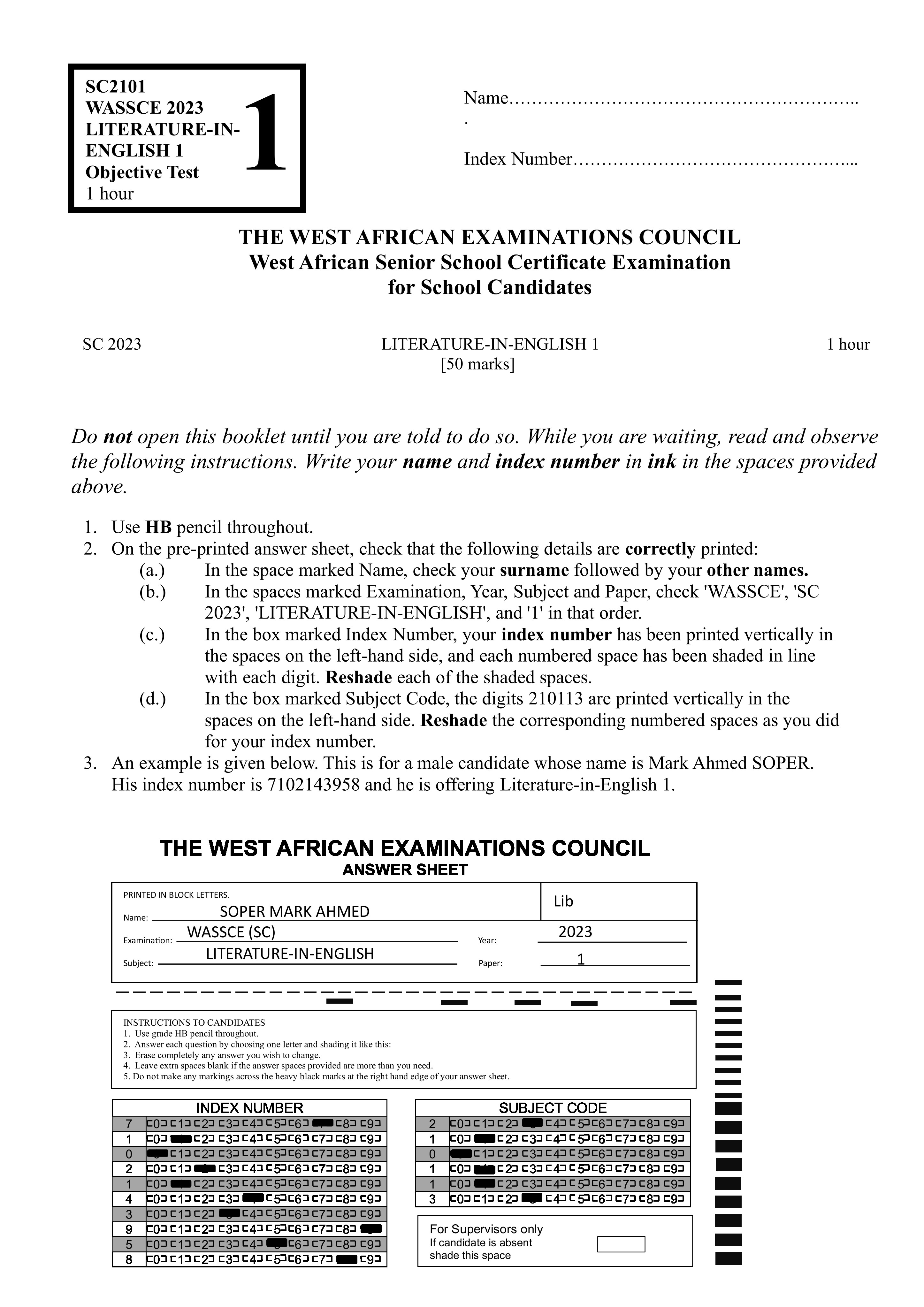
Answer all the questions
Each question is followed by four options lettered A to D. Find the correct option for each question and shade in pencil on your answer sheet, the answer space which bears the same letter as the option you have chosen.An example is given below
"All the world's a stage" is an example of
A. metaphor.
B. paradox.
C. allusion.
D. personification.
The correct answer is metaphor, which is lettered A, and therefore answer space A would be shaded.


Think carefully before you shade the answer space; erase completely any answer(s) you wish to change.
Do all rough work on this question paper.
Now answer all the following questions:
SECTION A
Answer all the questions in this section.
PART I
GENERAL KNOWLEDGE OF LITERATURE
Explanation:
The correct answer is:
C. Non-fiction
Topic: Literary Genres
Letters, journals, and diaries are considered non-fiction because they describe real events and the author's personal thoughts or experiences.
Here's why the other answers are wrong:
Explanation:
The correct answer is:
C. Euphemism
Topic: Figures of Speech
The phrase "put in the family way" is a euphemism. A euphemism is a way of saying something more gently or politely, especially when the topic is sensitive. In this case, it is used to describe pregnancy in a less direct way.
Here's why the other answers are wrong:
Explanation:
The correct answer is:
C. Flat
Topic: Character Development
A flat character is one-dimensional and represents a single trait or quality. They do not undergo significant changes or growth throughout the story.
Here's why the other answers are incorrect:
Explanation:
The correct answer is:
C. Heptametre
Topic: Poetic Forms
Heptametre refers to a line of poetry that has seven metrical feet. It is often used in long poems and provides a rhythmic structure that is both expansive and varied.
Here’s why the other answers are incorrect:
Explanation:
The correct answer is:
B. Overused and ineffective
Topic: Figures of Speech
A dead metaphor is one that has been used so many times that it no longer has any impact. It loses its original meaning and becomes just a standard phrase.
Here’s why the other answers are incorrect:
Read the extract below and answer Questions 6 and 10.
(In the Town Hall)
Jonsey: (By himself centre right, looking skulky)
How does anyone keep faith with himself in such an ill made place?
Bassy, Ba-a-ssy!
Bassy: Here. Anything the matter?
Jonsey: (Moves front stage centre right) Your mayoral hopeful.
Explanation:
The correct answer is:
A. soliloquy
Topic: Dramatic Techniques
A soliloquy is a speech where a character talks to themselves, sharing their personal thoughts and feelings. In Jonsey's speech, "How does anyone keep faith with himself in such an ill-made place?" he seems to be speaking to himself, which makes it a soliloquy.
Here's why the other answers are wrong:
Explanation:
The correct answer is:
D. setting
Topic: Literary Elements
"In the Town Hall" refers to the place where the scene is taking place, which is the setting. The setting is not only the physical location but also the time, environment, and context in which the events of the story occur.
Here's why the other answers are wrong:
Explanation:
The correct answer is:
B. character
Topic: Dramatic Elements
Bassy is a character in the play because he interacts with other characters, like Jonsey, and is involved in the dialogue. He is not the director or narrator, and does not serve as a producer. He is an active part of the story.
Here's why the other answers are wrong:
Explanation:
The correct answer is:
C. Bassy
Topic: Dialogue and Address
The phrase "Your mayoral hopeful" is directed at Bassy. Jonsey is referring to him in the context of the mayoral race, indicating that Jonsey is speaking directly to Bassy.
Here's why the other answers are wrong:
Explanation:
The correct answer is:
C. dialogue
Topic: Types of Speech
Dialogue is a conversation between two or more characters. Since Jonsey and Bassy are speaking to each other, their exchange is considered dialogue, not a monologue or any other type of speech.
Here's why the other answers are wrong:
Explanation:
The correct answer is:
B. final outcome
Topic: Literary Terms
Resolution is the final part of a story where the conflicts are resolved, and the story comes to a conclusion. It provides closure to the events that took place throughout the plot.
Here's why the other answers are wrong:
Explanation:
The correct answer is:
C. pathetic fallacy
Topic: Literary Devices
Pathetic fallacy occurs when human emotions or qualities are attributed to non-human things, like nature or objects. In this case, the moon is described as feeling horror, which is a human emotion. This is an example of pathetic fallacy.
Here's why the other answers are wrong:
Explanation:
The correct answer is:
B. Pantomime
Topic: Drama
Pantomime is a type of performance where actors use only their body movements and facial expressions to tell a story, without speaking. It is a way of telling a story without words.
Here's why the other answers are wrong:
Explanation:
The correct answer is:
B. Threnody
Topic: Poetry
A threnody is a short poem written to express sadness about someone's death. It is a way of mourning and showing respect for the person who has passed away.
Here's why the other answers are wrong:
Explanation:
The correct answer is:
A. Quatrain
Topic: Sonnet Structure
A Shakespearean sonnet is made up of three quatrains (four-line sections) and a final couplet (two-line section). The third stanza in this sonnet is a quatrain, which is one of the four-line sections before the two-line ending.
Here's why the other answers are wrong:
Read the extract below and answer Questions 16 and 17.
The boat nodded in timing with the gentle
Bobbing of the float on the unhurrying
Tide as the angler awaited the bite and
Pull of a salmon
Explanation:
The correct answer is:
B. Calm weather
Topic: Imagery
The extract describes a calm and peaceful scene, with phrases like "gentle bobbing" and "unhurrying tide" that suggest a quiet, still environment. These words create an image of calm weather, not a bright day or rough time.
Here's why the other answers are wrong:
Explanation:
The correct answer is:
B. Personification
Topic: Literary Devices
The extract uses personification, where non-human things are given human qualities. For example, the boat is described as "nodding" and the tide as "unhurrying," both giving them human-like actions.
Here's why the other answers are wrong:
Explanation:
The correct answer is:
C. An apologue
Topic: Fables
A fable is a short story, usually with animals, that teaches a lesson. "Apologue" is another word for fable, and both terms refer to stories that teach a moral.
Here's why the other answers are wrong:
Explanation:
The correct answer is:
A. Caricature
Topic: Exaggeration in Art
A caricature is when someone's features are exaggerated in a funny way. It focuses on making certain traits stand out, often for comedic effect.
Here's why the other answers are wrong:
Explanation:
The correct answer is:
B. Synecdoche
Topic: Figurative Language
The phrase "last head count" uses "head count" as synecdoche. In this case, "heads" (part of the body) stands for people, representing the whole group of people in the school. This is a common way of using a part to represent the whole.
Here's why the other answers are wrong:
PART II
UNSEEN PROSE AND POETRY
Read the passage and answer Questions 21 to 25.
Along marched the crowd, determined not to be distracted from its cause and the course it had charted. If anyone could intimidate the chief, it was Sasu, who led the crowd. The chief nurtured unruffled restraint. He knew Sasu, knew that Sasu would not waste the trust between them on renegades.
One way to divert a mob from its goal is to join in with it, lead it on, but finally, veer it from the course of its cause. Onward, towards the chief's palace marched the crowd, singing war songs.
The sun frowned as the palace guards, rattling like leaves in a storm, fear branded on their faces, came out to survey the threatening crowd and prepare for a siege. Just then, Sasu turned about, heading away from the palace - with the crowd, and the war songs.
Explanation:
The correct answer is:
A. Tense
Topic: Atmosphere
The passage describes a crowd marching toward the chief's palace, while the palace guards are fearful. The uncertainty and fear create a tense atmosphere, especially as the crowd approaches with possible violence in the air.
Here's why the other answers are wrong:
Explanation:
The correct answer is:
D. Parallelism
Topic: Literary Devices
The sentence uses parallel structure by repeating similar grammatical patterns: "join in with it, lead it on, but, finally, veer it from." This repetition helps highlight the sequence of actions and emphasizes the manipulation of the crowd's direction.
Here's why the other answers are wrong:
Explanation:
The correct answer is:
C. Approval
Topic: Attitude
The writer describes Sasu in a positive light, focusing on his leadership and ability to control the crowd calmly. This shows respect for Sasu's restraint and skill, which reflects an approving attitude towards his actions.
Here's why the other answers are wrong:
Explanation:
The correct answer is:
D. Personification and Simile
Topic: Literary Devices
The phrase "rattling like leaves in a storm" is a simile because it compares the guards' fear to the sound of leaves. "Fear branded on their faces" is personification because it gives fear human-like qualities, suggesting it can be physically marked on someone's face.
Here's why the other answers are wrong:
Explanation:
The correct answer is:
C. Anti Climax
Topic: Plot Structure
The paragraph builds tension as the crowd moves toward the palace, but Sasu unexpectedly turns them away. This twist defies the expected climax of a confrontation, leading to an anti-climactic moment.
Here's why the other answers are wrong:
Read the poem and answer Questions 26 to 30
Miniver Cheevy, child of scorn
Grew lean while he assailed the season;
He wept that he was ever born,
And he had reasons.
Miniver loved the days of old
When swords were bright and steeds prancing;
The vision of a warrior bold
Would set him dancing.
Explanation:
The correct answer is:
D. Metaphor
Topic: Literary Devices
"Child of scorn" is a metaphor. Miniver Cheevy is not really a child of scorn. The phrase means that he was full of scorn — in other words, he felt strong dislike, disrespect, or hatred for the world around him. It shows that his thoughts and feelings were shaped by this attitude.
Why the other answers are wrong:
Explanation:
The correct answer is:
C. Iambic
Topic: Metrical Structure
The poem is written mostly in iambic meter. This means each line has a pattern of one soft beat followed by one strong beat, like this: da-DUM. This pattern is very common in English poems because it sounds natural, like regular speech.
Why the other answers are wrong:
Explanation:
The correct answer is:
C. Ironic
Topic: Tone
The poet is being ironic. Miniver Cheevy dreams about the past and complains about the present, but the poet shows that Miniver is wasting his life by doing nothing. The poem says one thing on the surface, but it really means something else — this is irony.
Why the other answers are wrong:
Explanation:
The correct answer is:
D. Fantasizing
Topic: Characterization
In the last part of the poem, Miniver Cheevy is fantasizing. He imagines living in the past when there were brave warriors and exciting battles. He dreams about a better life instead of accepting the present. This shows he is lost in his thoughts and wishes.
Why the other answers are wrong:
Explanation:
The correct answer is:
C. Alternate rhyme
Topic: Rhyme Scheme
The poem uses an alternate rhyme pattern. This means the first and third lines rhyme with each other, and the second and fourth lines rhyme too. This is called ABAB rhyme scheme.
Why the other answers are wrong:
SECTION B
Answer all the questions in this section.
WILLIAM SHAKESPEARE; A Midsummer Night 's Dream
Read the extract below and answer Questions 31 to 35
As waggish boys in a game themselves forswear;
So the boy Love is perjured everywhere;
For ere Demetrius looked on Hermia's eyne,
He hailed down oaths that he was only mine;
And when this hail some heat from Hermia felt,
So he dissolved, and showers of oaths did melt.
Explanation:
The correct answer is:
A. Helena
Topic: William Shakespeare; A Midsummer Night's Dream
In this extract, Helena is speaking about how love is untrustworthy and changes quickly. She feels sad because Demetrius once promised to love only her, but now he loves Hermia instead.
Here's why the other answers are wrong:
Explanation:
The correct answer is:
B. In a bad mood
Topic: William Shakespeare; A Midsummer Night's Dream
The speaker is in a bad mood. She is upset because love is not reliable. Demetrius changed his feelings from her to Hermia, which makes her feel hurt and betrayed.
Here's why the other answers are wrong:
Explanation:
The correct answer is:
B. Being rejected by the lover
Topic: William Shakespeare; A Midsummer Night's Dream
The speaker feels upset because Demetrius, who once loved her, has rejected her and now loves Hermia instead. This rejection causes her sadness and anger.
Here's why the other answers are wrong:
Explanation:
The correct answer is:
C. Hermia
Topic: William Shakespeare; A Midsummer Night's Dream
The speaker, Helena, has just said goodbye to Hermia. She is feeling sad and hurt because Hermia has won Demetrius’s love, while Helena has been rejected.
Here's why the other answers are wrong:
Explanation:
The correct answer is:
D. Theseus
Topic: William Shakespeare; A Midsummer Night's Dream
Helena decides to tell Theseus about Hermia's disloyalty. She feels hurt and betrayed by Hermia and Demetrius and hopes that Theseus will punish Hermia. Helena thinks Hermia has broken their friendship by loving Demetrius.
Here's why the other answers are wrong:
Read the extract below and answer Questions 36 to 40
Lysander riddles very prettily;
Now much beshrew my manners and my pride,
If Hermia meant to say Lysander lied.
But, gentle friend, for love and courtesy
Lie further off, in human modesty;
Such separation as may well be said
Becomes a virtuous bachelor and a maid;
So far be distant, and good night, sweet friend:
Thy love ne'er alter, till thy sweet life end!
Explanation:
The correct answer is:
B. Helena
Topic: William Shakespeare; A Midsummer Night's Dream
The speaker is Helena. She is talking to Lysander and expressing her feelings about love and how she thinks Lysander's words are true. This happens in the scene where Helena feels confused and frustrated about the love between the characters.
Here is why the other answers are wrong:
Explanation:
The correct answer is:
C. The woods
Topic: William Shakespeare; A Midsummer Night's Dream
The speech is made in the woods. Most of the play’s magical events take place there. Helena speaks here after Lysander has been enchanted by the love potion.
Here is why the other answers are wrong:
Explanation:
The correct answer is:
D. Lovers
Topic: William Shakespeare; A Midsummer Night's Dream
The speaker, Helena, is speaking to Lysander. Their relationship is that of lovers, although at this point in the play, Lysander's love is confused because of the magic in the woods. Helena’s feelings show unrequited love and hope for Lysander’s affection.
Here is why the other options are wrong:
Explanation:
The correct answer is:
C. Alliteration
Topic: William Shakespeare; A Midsummer Night's Dream
This phrase uses alliteration. The repetition of the "m" sound in "manners" and "my" and the "p" sound in "pride" creates a rhythm and draws attention to Helena’s feelings. It shows her frustration with how she is behaving toward Lysander.
Why the other options are incorrect:
Explanation:
The correct answer is:
A. An undying love
Topic: William Shakespeare; A Midsummer Night's Dream
The phrase shows Helena's wish that Lysander's love will never change and will last until his death. It expresses a hope for a love that is eternal and unchanging, showing how deeply Helena cares for him.
Why the other options are incorrect:
Read the extract below and answer Questions 41 to 45
That fallen am I in dark uneven way,
...... Come, thou gentle day;
For if but once thou show me thy grey light,
I'll find …….., and revenge this spite.
Explanation:
The correct answer is:
C. Lysander
Topic: William Shakespeare; A Midsummer Night's Dream
Lysander speaks these lines in Act 2, Scene 2. He is lost in the woods and troubled by the magic spell that has made him love Helena instead of Hermia. The lines show his confusion and his hope to fix this problem and get revenge on the cause of his pain.
Why the other options are incorrect:
Explanation:
The correct answer is:
C. Hermia
Topic: William Shakespeare; A Midsummer Night's Dream
In Act 2, Scene 2, Lysander speaks these words thinking about Hermia, his true love. Although the magic spell makes him confused and changes his feelings later, here he is addressing Hermia and expressing his emotions about their situation.
Why the other options are incorrect:
Explanation:
The correct answer is:
D. The woods
Topic: William Shakespeare; A Midsummer Night's Dream
Lysander is in the woods, which is a key setting in the play. The forest is where much of the magical confusion and action happens. The phrase "dark uneven way" highlights the confusion Lysander feels due to the enchantment he is under.
Why the other options are incorrect:
Explanation:
The correct answer is:
B. Apostrophe
Topic: Literary Devices; Apostrophe
The phrase "Come, thou gentle day" is an example of apostrophe, a figure of speech in which the speaker directly addresses an absent or imaginary person, or a personified abstraction—in this case, the day. This device expresses the speaker’s longing for the day to arrive and bring relief.
Why the other options are incorrect:
Explanation:
The correct answer is:
D. Falls asleep
Topic: William Shakespeare; A Midsummer Night's Dream
After speaking these lines, Lysander falls asleep in the forest due to the effects of Puck’s enchantment. His sleep reflects the magical confusion and turmoil that the characters experience, setting the stage for the resolution of their complicated relationships.
Why the other options are incorrect:
Read the extract and answer Questions 46 to 50.
He hath rid his prologue like a rough colt: he knows not the stop. A good moral, my lord: it is not enough to speak, but to speak true.
Explanation:
The correct answer is:
A. Bottom
Topic: William Shakespeare; A Midsummer Night's Dream
Bottom says this line. He is talking about the way one of the workers reads the prologue and says it badly. Bottom is funny and doesn’t understand acting well.
Why the other choices are wrong:
Explanation:
The correct answer is:
A. Theseus
Topic: William Shakespeare; A Midsummer Night's Dream
Theseus speaks just before Bottom in this scene. He is the Duke of Athens and is part of the conversation before the workers start their play.
Why the other choices are wrong:
Explanation:
The correct answer is:
C. Epigram
Topic: William Shakespeare; A Midsummer Night's Dream
This phrase is an epigram because it is a short and clever statement that teaches a truth or lesson about speaking honestly.
Why the other choices are wrong:
Explanation:
The correct answer is:
A. Hippolyta
Topic: William Shakespeare; A Midsummer Night's Dream
After Bottom speaks, Hippolyta, the queen, replies. They are talking about the funny play put on by the workers.
Why the other choices are wrong:
Explanation:
The correct answer is:
C. Quince
Topic: William Shakespeare; A Midsummer Night's Dream
Quince is the leader of the workers and he reads the prologue at the start of their play. He tries to explain what will happen in the play to the audience.
Why the other choices are wrong:
Our Mission: To provide free, accessible, and comprehensive exam preparation resources for West African students preparing for their WASSCE and LJHSCE examinations.
StudyWASSCE was created in 2023 by an independent content creator who recognized a critical gap in accessible educational resources for West African students. After witnessing countless students struggle to find quality past examination papers and affordable study materials, I dedicated myself to building a comprehensive, completely free platform that would level the playing field for all students, regardless of their economic background.
As an independent educational content creator, I have invested countless hours researching, compiling, and organizing past examination papers from official sources. My commitment stems from a deep belief that every student deserves access to quality educational resources, regardless of their financial circumstances.
Unlike general educational platforms, StudyWASSCE specializes exclusively in:
StudyWASSCE operates on a sustainable model that keeps education free while ensuring quality:
Since launching, StudyWASSCE has:
As an independent creator, I am committed to:
We welcome partnerships with:
As the independent creator behind StudyWASSCE, I personally respond to:
Response Commitment: I personally review and respond to all messages within 48-72 hours.
Education transformed my life, and I believe it can transform the lives of every student who has access to quality resources. StudyWASSCE represents my personal commitment to ensuring that no student is left behind due to lack of access to study materials. Every hour I spend improving this platform is an investment in the future of West African education.
Thank You for Your Support! By using StudyWASSCE and viewing our advertisements, you help sustain this free educational resource. Your success is our success, and every student who passes their examinations using our materials validates our mission.
StudyWASSCE: Created by an independent educator, for students everywhere.
Empowering West African students through free, accessible education.
StudyWASSCE is an independent educational platform created to provide free access to past exam papers and study materials for WASSCE and LJHSCE examinations. We are committed to helping students succeed while maintaining transparency about our data practices.
To improve our service and comply with advertising requirements, we collect the following information:
We use collected information to:
Our site is supported by advertising to keep educational content free. We work with the following third-party services:
We do not sell or rent personal information. We may share data with:
Required for Site Access: By using StudyWASSCE, you consent to our data collection practices as described in this policy. This includes:
Your Options:
Note: Continued use of our platform indicates your ongoing consent to these practices.
We implement appropriate technical and organizational security measures to protect the information we collect. However, no internet transmission is completely secure, and we cannot guarantee absolute security.
Our site is designed for students of all ages. We do not knowingly collect personal information from children under 13 without parental consent. If you believe we have collected such information, please contact us immediately.
Our site is hosted and operated from servers that may be located in different countries. By using our site, you consent to the transfer of your information to these locations.
We may update this privacy policy periodically to reflect changes in our practices or legal requirements. We will post any changes on this page with an updated revision date. Continued use of our site after changes constitutes acceptance of the updated policy.
If you have any questions about this privacy policy or our data practices, please contact us via WhatsApp at +231-770450825, by email at davidlamine96@gmail.com, or through our Facebook page @Study For WASSCE.
Last Updated: January 15, 2025
Important Notice: By using StudyWASSCE, you agree to these Terms of Service and our Privacy Policy. This site uses cookies and displays advertisements to provide free educational content.
StudyWASSCE is an independent educational platform created and maintained by a dedicated content creator who has worked extensively to compile and organize past examination papers for WASSCE (West African Senior School Certificate Examination) and LJHSCE (Liberian Junior High School Certificate Examination). Our mission is to provide free access to quality educational resources for students preparing for these national examinations.
All examination papers, questions, and educational materials on this platform have been carefully curated from publicly available past examination papers. We provide:
By accessing, browsing, or using StudyWASSCE in any way, you acknowledge that you have read, understood, and agree to be bound by these Terms of Service and our Privacy Policy. If you do not agree to these terms, please discontinue use of our platform immediately.
StudyWASSCE provides completely free access to all educational content. You are not required to:
To maintain this free service, StudyWASSCE is supported by:
Required for Free Access: Advertisements are essential to maintaining our free educational service. By using StudyWASSCE, you consent to the display of advertisements throughout the platform.
Our advertising practices comply with Google AdSense policies:
Essential for Site Operation: StudyWASSCE uses cookies for:
By using our site, you consent to our use of cookies as described in our Privacy Policy.
StudyWASSCE grants you a limited, non-exclusive, non-transferable license to access and use our content for personal educational purposes only. You may:
You may NOT:
While individual examination questions may be public domain, our compilation, organization, explanations, and presentation represent original work protected by intellectual property rights.
We use Google Analytics to collect anonymous usage data to improve our educational content and user experience. This includes:
We use this data to:
Users must:
StudyWASSCE is designed for students of all ages. Users under 13 should have parental consent before using our platform, particularly regarding cookie acceptance and data collection.
While we strive for accuracy in all educational content:
Important: StudyWASSCE is a study supplement and should not replace formal education, textbooks, or qualified instruction. Users should use our resources alongside official study materials and classroom learning.
We strive to maintain consistent platform availability, but cannot guarantee:
We reserve the right to:
We are committed to protecting user privacy while providing free educational services. Our data collection practices are detailed in our Privacy Policy and comply with:
Our platform integrates with reputable third-party services that have their own privacy policies:
StudyWASSCE is provided "as is" for educational purposes. We disclaim liability for:
In no event shall StudyWASSCE be liable for any indirect, incidental, special, or consequential damages arising from platform use, even if advised of the possibility of such damages.
Our advertising practices comply with:
We respect intellectual property rights and maintain compliance with copyright laws regarding educational fair use of examination materials.
We regularly update our platform with:
We reserve the right to modify these Terms of Service to:
Updated terms will be posted on this page with revision dates. Continued use after changes constitutes acceptance of updated terms.
These Terms of Service shall be governed by and construed in accordance with the laws of the Republic of Liberia. Any disputes arising from these terms or platform use shall be subject to the jurisdiction of Liberian courts.
If any provision of these Terms of Service is found to be unenforceable or invalid, that provision shall be limited or eliminated to the minimum extent necessary so that the remaining terms remain in full force and effect.
These Terms of Service, together with our Privacy Policy, constitute the entire agreement between you and StudyWASSCE regarding platform use and supersede all prior agreements or understandings.
For questions about these Terms of Service, content issues, or platform feedback, please contact us through:
For Urgent Issues: Technical problems affecting site access, inappropriate advertisements, or content errors.
For Partnership Inquiries: Educational institutions, content contributors, or collaboration opportunities.
Thank you for using StudyWASSCE! Your use of our platform helps us continue providing free educational resources to students across West Africa. We appreciate your support through advertisement viewing and ethical use of our content.
© 2025 StudyWASSCE. All rights reserved.
Supporting West African education through free access to quality study materials.