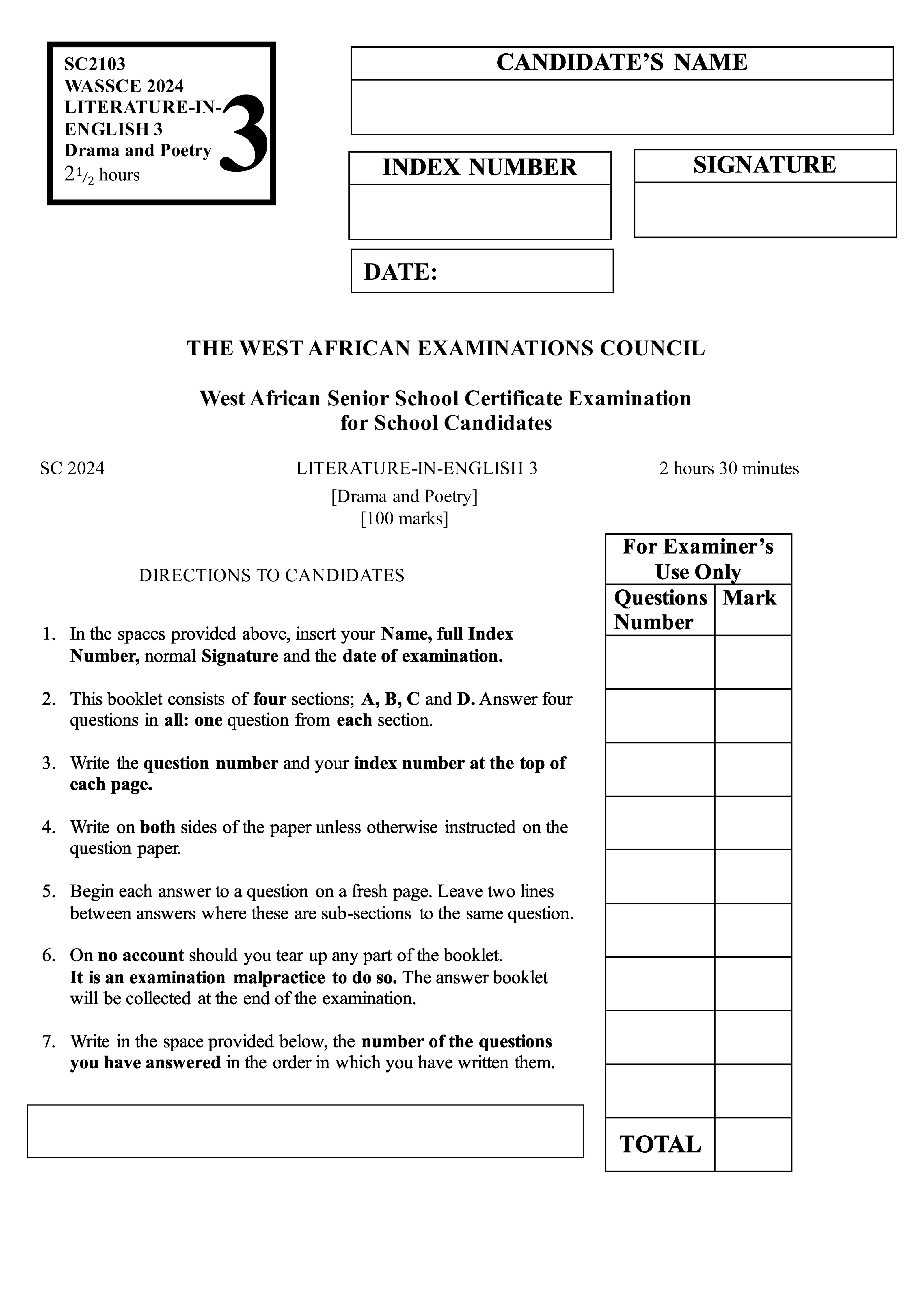
PAPER 3
[100 marks]
DRAMA AND POETRY
All questions carry equal marks.
Answer four questions in all; one question from each section. Develop not fewer than five points in your answers.
SECTION A
AFRICAN DRAMA
Answer one question only from this section.
JOHN, K. KARGBO: Let me Die Alone
1. Show how the dreams of Gbanya foreshadow events in the play.
[25 marks]
Gbanya's dreams act as warnings about the betrayals, challenges, and changes that lead to his tragic end and the shift in leadership.
In his dreams, Gbanya feels like someone close to him might betray him. Later in the play, this happens when Yoko, his wife, puts her ambition to become a leader above her loyalty to him. This betrayal leads to his downfall.
Gbanya dreams about things that suggest death is near, like seeing dark or scary images. This comes true when he is poisoned by people he trusted. His death is not just personal but also marks the end of his time as leader.
Gbanya dreams about problems and challenges in his leadership. This predicts the way the British governor humiliates him and weakens his authority. These events make it easier for others to take advantage of him.
Gbanya's dreams make him uneasy about people around him who seem too eager for power. Later, we see Yoko's strong desire to lead. She cleverly takes over after Gbanya's death, as the dreams warned.
Gbanya's dreams show his fear of losing his traditional ways and reputation. After his death, Yoko becomes leader, but she focuses more on gaining power than preserving traditions. This makes Gbanya's fears come true.
2. Examine the portrayal of Yoko's death.
[25 marks]
Yoko's death shows the price she paid for power. She was a strong and ambitious woman, but her choices and the challenges around her led to her sad end, when she committed suicide.
Yoko ends up dying all by herself. Even though she was a powerful leader, she had no one left because her actions made her lose the people she cared about. This shows how lonely she became because of her choices.
Yoko worked hard to become a strong leader, especially as a woman in a man's world. But her death is very sad because it shows how hard it was for her to keep that power.
Yoko's death may show that she couldn't handle the guilt and sadness from the decisions she made. She might have felt bad for hurting people or being betrayed and chose to end her pain.
Yoko always wanted to be powerful, but in the end, that ambition brought her troubles. She had to make tough decisions, and those choices eventually led to her tragic death.
Yoko's death shows how hard life was for women in her position during her time. As a leader, she faced many challenges, and her death reminds us of how much pressure women like her had to deal with.
WOLE, SOYINKA: The Lion and the Jewel
3. Compare Baroka to Lakunle in the play.
[25 marks]
Baroka represents tradition, valuing customs like the bride price and polygamy to keep his power. Lakunle, on the other hand, rejects these traditions and prefers modern Western ideas, like not paying the bride price.
Baroka uses his charm and wisdom to win Sidi, showing the power of traditional relationships. Lakunle, however, treats Sidi with disrespect, expecting her to follow his modern ideas without considering her views.
Baroka is smart, confident, and uses his experience to get what he wants. Lakunle is energetic but naive, and his ideas about modernity make him seem out of touch with the village.
Baroka is a respected village leader, using his position and influence to maintain control. Lakunle is just a teacher, and his modern ideas don't have the same impact, so he doesn't hold much power.
Baroka wins Sidi by using cleverness and tradition, showing that tradition can still succeed. Lakunle loses because his refusal to respect tradition pushes Sidi away, proving that change must respect the old ways.
4. Discuss three elements of tradition in the play.
[25 marks]
One element of tradition in the play is the Bride Price. In the village, paying the bride price is a key part of marriage, symbolizing respect and the transfer of a woman between families. Baroka insists on this practice, but Lakunle rejects it, believing it is outdated and should be replaced with a modern approach to relationships.
Another traditional element is Polygamy. Baroka, as the village chief, practices polygamy, having multiple wives as part of his role and status. This tradition is accepted by the villagers, but Lakunle, who represents modernity, sees it as a backward practice and criticizes it.
Cultural Respect is also a significant tradition in the play. Baroka maintains his power and influence in the village by respecting the customs and practices that have been passed down through generations. This respect for tradition is part of his authority as the Bale.
In the village, elders like Baroka are highly respected, and their wisdom and experience are valued. Lakunle challenges this hierarchy by dismissing the role of elders, believing that modern education should override traditional structures.
Baroka's ability to win Sidi through traditional means, like his cleverness and use of rituals, highlights the importance of these customs in maintaining social order and reinforcing tradition in the village.
SECTION B
NON-AFRICAN DRAMA
Answer one question only from this section.
JOHN, OSBORNE: Look Back in Anger
5. Examine Cliff's role in the play.
[25 marks]
Cliff Lewis is an important character in the play Look Back in Anger. He is not the main character, but he plays a key role in the story.
Cliff is the peacemaker in the play. He tries to calm down the arguments between Jimmy, who is angry all the time, and Alison, his wife. When things get too heated, Cliff steps in to help, showing that he is more gentle and understanding than Jimmy.
Cliff is also like Jimmy in some ways (they are both from working-class backgrounds), but he doesn't have the same anger. While Jimmy is upset about life, Cliff is more content with what he has. This makes Cliff's character opposite to Jimmy and highlights how angry and frustrated Jimmy is.
Cliff is Alison's friend, and he is there for her when things are tough with Jimmy. He listens to her and tries to comfort her when she feels upset. He helps her when Jimmy isn't being kind to her, showing how loyal and caring Cliff is.
Cliff comes from a working-class background, just like Jimmy. However, while Jimmy is angry about their class and the way society treats people like them, Cliff doesn't seem to mind so much. He is okay with his life, even though it's not perfect. He represents a more accepting view of their situation compared to Jimmy.
Cliff seems to care for Alison a lot, and it's hinted that he might have feelings for her. He supports her emotionally and seems to care deeply for her, but he never acts on these feelings. He respects her marriage to Jimmy and stays loyal to her, even though he might wish things were different.
6. Discuss the use of the following symbols: The Newspapers, The Trumpet and The Bear and Squirrel.
[25 marks]
The newspapers show Jimmy's anger and frustration with the world. He reads them to complain about society and politics, using them to express his unhappiness and sense of being stuck in a system he doesn't like.
Cliff's trumpet represents how he finds peace and relief from his troubles. While Jimmy is always angry, Cliff uses music as a way to relax and escape, showing that he deals with life's problems in a calmer way.
The bear and squirrel figurines show how different Jimmy and Alison are. Jimmy calls Alison a "squirrel," meaning she's quiet and gentle, while he sees himself as a "bear," big and aggressive, highlighting their emotional differences.
The bear and squirrel also show how the power in Jimmy and Alison's relationship is unbalanced. Jimmy is the dominant, aggressive one, while Alison is more passive and quiet, making her seem weaker and controlled by him.
The trumpet and newspapers show how Cliff and Jimmy handle life differently. Jimmy uses the newspapers to express his anger about everything, while Cliff uses the trumpet to stay calm and peaceful, dealing with stress in a more relaxed way.
AUGUST, WILSON: Fences
7. What events in Troy's early life shape his present character?
[25 marks]
Troy Maxson's early life greatly shapes who he is in Fences. His struggles with hardship, racism, and family issues strongly influence his actions and views on life.
Troy wanted to play professional baseball, but racism stopped him. This made him bitter and angry at the world.
Troy went to prison for robbery, where he learned to play baseball. Prison life made him tough and distrustful.
Troy's father was mean and abusive, so he left home young. This made Troy a strict and controlling father.
Troy grew up poor and had to work hard just to survive. This taught him to see life as a struggle and not to dream big.
Troy felt hurt that his dreams never came true. He tried to stop his son from chasing dreams to protect him from the same pain.
8. What role does setting play in Fences?
[25 marks]
The setting of Fences is a 1950s backyard in a modest Black neighborhood in Pittsburgh, Pennsylvania.
The play is set in the 1950s, a time when racial segregation and limited opportunities for Black Americans were still prevalent. This context highlights the barriers Troy faced and helps explain his bitterness and frustration.
Most of the play takes place in Troy's backyard, symbolizing his personal space and the life he has built for his family. The backyard serves as a stage for his conflicts, dreams, and struggles.
The fence being built around the yard symbolizes both protection and division. For Rose, it represents safety and keeping her family together, while for Troy, it reflects his emotional barriers.
The modest home and neighborhood reflect the economic limitations faced by Black families during that era. This setting emphasizes the theme of survival and the hard work required to maintain even a modest living.
The neighborhood represents the close-knit Black community where people share their joys and struggles. This backdrop highlights the importance of community support amidst the challenges of racism and economic hardship.
SECTION C
AFRICAN POETRY
Answer one question only from this section.
9. Discuss The Leader and the Led as a rejection of tyranny
[25 marks]
The poem uses animals to represent different types of leaders, such as the lion for harsh rule, the hyena for selfishness, and the giraffe for being out of touch with the people.
The poem criticizes leaders who stay in power by using fear and exploitation, causing suffering rather than peace or stability.
The poem argues that leadership should not be controlled by one person but should involve working together and considering the needs of the community.
Osundare emphasizes the need for leaders who listen, consult, and act in the best interest of everyone, as opposed to autocrats who make decisions without input from others.
The poem reflects on Africa's struggles with colonialism, dictatorship, and the ongoing fight for fair governance, urging leaders to serve the people, not themselves.
10. Did the government driver enjoy his service to his country in A Government Driver on his Retirement?
[25 marks]
The poem shows how the driver's retirement, instead of being a joyful new start, is marked by regret, alcohol, and a tragic end.
The driver is happy to retire after 35 years of work, feeling free from the rules and celebrating with his friends.
During the celebration, the driver drinks alcohol to forget the struggles and hardships he faced during his career.
The driver is given a new car as a gift for his long service, but it doesn't bring him true joy, symbolizing that recognition can't fix the emotional toll of his work.
The poem shows how the driver's years of service and alcohol have drained him physically and emotionally.
Despite the celebration, the driver crashes his new car while drunk and dies, showing that his retirement didn't bring the happiness he expected.
SECTION D
NON-AFRICAN POETRY
Answer one question only from this section.

11. How does the poet express his disappointment on seeing the bats in Bat?
[25 marks]
Lawrence feels surprised and uncomfortable when he sees the bats. Instead of finding them interesting, they make him feel uneasy.
He talks about the bats in a way that doesn't sound nice. Their fast, crazy movements make them seem scary, not beautiful.
Bats are often thought of as a symbol of death, and Lawrence thinks of them this way, which makes him like them even less.
Lawrence probably wanted to see something calm or pretty in nature, but the bats don't fit that. Their wild flying makes him feel disturbed.
Lawrence feels bad about nature. Instead of seeing something happy or nice, he thinks nature is dirty and dark, which makes him feel sad.
12. Examine the use of euphemism in Do not Go Gentle into that Good Night.
[25 marks]
Dylan Thomas uses the phrase "good night" instead of saying "death." This makes dying sound more peaceful, like going to sleep, not something scary.
"Dying of the light" means life is ending, where "light" stands for life itself. It makes death seem slower and less harsh, like the sun setting.
The word "grave" shows that something serious is happening but doesn't directly say someone is dying. It focuses more on respect and wisdom, not just the end of life.
"Blind eyes" suggests a person is getting weaker or aging. It gently shows decline without directly saying someone is losing strength or getting old.
Thomas uses these gentle words to make death and aging seem less scary. It lets him talk about tough topics in a soft and respectful way.
Our Mission: To provide free, accessible, and comprehensive exam preparation resources for West African students preparing for their WASSCE and LJHSCE examinations.
StudyWASSCE was created in 2023 by an independent content creator who recognized a critical gap in accessible educational resources for West African students. After witnessing countless students struggle to find quality past examination papers and affordable study materials, I dedicated myself to building a comprehensive, completely free platform that would level the playing field for all students, regardless of their economic background.
As an independent educational content creator, I have invested countless hours researching, compiling, and organizing past examination papers from official sources. My commitment stems from a deep belief that every student deserves access to quality educational resources, regardless of their financial circumstances.
Unlike general educational platforms, StudyWASSCE specializes exclusively in:
StudyWASSCE operates on a sustainable model that keeps education free while ensuring quality:
Since launching, StudyWASSCE has:
As an independent creator, I am committed to:
We welcome partnerships with:
As the independent creator behind StudyWASSCE, I personally respond to:
Response Commitment: I personally review and respond to all messages within 48-72 hours.
Education transformed my life, and I believe it can transform the lives of every student who has access to quality resources. StudyWASSCE represents my personal commitment to ensuring that no student is left behind due to lack of access to study materials. Every hour I spend improving this platform is an investment in the future of West African education.
Thank You for Your Support! By using StudyWASSCE and viewing our advertisements, you help sustain this free educational resource. Your success is our success, and every student who passes their examinations using our materials validates our mission.
StudyWASSCE: Created by an independent educator, for students everywhere.
Empowering West African students through free, accessible education.
StudyWASSCE is an independent educational platform created to provide free access to past exam papers and study materials for WASSCE and LJHSCE examinations. We are committed to helping students succeed while maintaining transparency about our data practices.
To improve our service and comply with advertising requirements, we collect the following information:
We use collected information to:
Our site is supported by advertising to keep educational content free. We work with the following third-party services:
We do not sell or rent personal information. We may share data with:
Required for Site Access: By using StudyWASSCE, you consent to our data collection practices as described in this policy. This includes:
Your Options:
Note: Continued use of our platform indicates your ongoing consent to these practices.
We implement appropriate technical and organizational security measures to protect the information we collect. However, no internet transmission is completely secure, and we cannot guarantee absolute security.
Our site is designed for students of all ages. We do not knowingly collect personal information from children under 13 without parental consent. If you believe we have collected such information, please contact us immediately.
Our site is hosted and operated from servers that may be located in different countries. By using our site, you consent to the transfer of your information to these locations.
We may update this privacy policy periodically to reflect changes in our practices or legal requirements. We will post any changes on this page with an updated revision date. Continued use of our site after changes constitutes acceptance of the updated policy.
If you have any questions about this privacy policy or our data practices, please contact us via WhatsApp at +231-770450825, by email at davidlamine96@gmail.com, or through our Facebook page @Study For WASSCE.
Last Updated: January 15, 2025
Important Notice: By using StudyWASSCE, you agree to these Terms of Service and our Privacy Policy. This site uses cookies and displays advertisements to provide free educational content.
StudyWASSCE is an independent educational platform created and maintained by a dedicated content creator who has worked extensively to compile and organize past examination papers for WASSCE (West African Senior School Certificate Examination) and LJHSCE (Liberian Junior High School Certificate Examination). Our mission is to provide free access to quality educational resources for students preparing for these national examinations.
All examination papers, questions, and educational materials on this platform have been carefully curated from publicly available past examination papers. We provide:
By accessing, browsing, or using StudyWASSCE in any way, you acknowledge that you have read, understood, and agree to be bound by these Terms of Service and our Privacy Policy. If you do not agree to these terms, please discontinue use of our platform immediately.
StudyWASSCE provides completely free access to all educational content. You are not required to:
To maintain this free service, StudyWASSCE is supported by:
Required for Free Access: Advertisements are essential to maintaining our free educational service. By using StudyWASSCE, you consent to the display of advertisements throughout the platform.
Our advertising practices comply with Google AdSense policies:
Essential for Site Operation: StudyWASSCE uses cookies for:
By using our site, you consent to our use of cookies as described in our Privacy Policy.
StudyWASSCE grants you a limited, non-exclusive, non-transferable license to access and use our content for personal educational purposes only. You may:
You may NOT:
While individual examination questions may be public domain, our compilation, organization, explanations, and presentation represent original work protected by intellectual property rights.
We use Google Analytics to collect anonymous usage data to improve our educational content and user experience. This includes:
We use this data to:
Users must:
StudyWASSCE is designed for students of all ages. Users under 13 should have parental consent before using our platform, particularly regarding cookie acceptance and data collection.
While we strive for accuracy in all educational content:
Important: StudyWASSCE is a study supplement and should not replace formal education, textbooks, or qualified instruction. Users should use our resources alongside official study materials and classroom learning.
We strive to maintain consistent platform availability, but cannot guarantee:
We reserve the right to:
We are committed to protecting user privacy while providing free educational services. Our data collection practices are detailed in our Privacy Policy and comply with:
Our platform integrates with reputable third-party services that have their own privacy policies:
StudyWASSCE is provided "as is" for educational purposes. We disclaim liability for:
In no event shall StudyWASSCE be liable for any indirect, incidental, special, or consequential damages arising from platform use, even if advised of the possibility of such damages.
Our advertising practices comply with:
We respect intellectual property rights and maintain compliance with copyright laws regarding educational fair use of examination materials.
We regularly update our platform with:
We reserve the right to modify these Terms of Service to:
Updated terms will be posted on this page with revision dates. Continued use after changes constitutes acceptance of updated terms.
These Terms of Service shall be governed by and construed in accordance with the laws of the Republic of Liberia. Any disputes arising from these terms or platform use shall be subject to the jurisdiction of Liberian courts.
If any provision of these Terms of Service is found to be unenforceable or invalid, that provision shall be limited or eliminated to the minimum extent necessary so that the remaining terms remain in full force and effect.
These Terms of Service, together with our Privacy Policy, constitute the entire agreement between you and StudyWASSCE regarding platform use and supersede all prior agreements or understandings.
For questions about these Terms of Service, content issues, or platform feedback, please contact us through:
For Urgent Issues: Technical problems affecting site access, inappropriate advertisements, or content errors.
For Partnership Inquiries: Educational institutions, content contributors, or collaboration opportunities.
Thank you for using StudyWASSCE! Your use of our platform helps us continue providing free educational resources to students across West Africa. We appreciate your support through advertisement viewing and ethical use of our content.
© 2025 StudyWASSCE. All rights reserved.
Supporting West African education through free access to quality study materials.