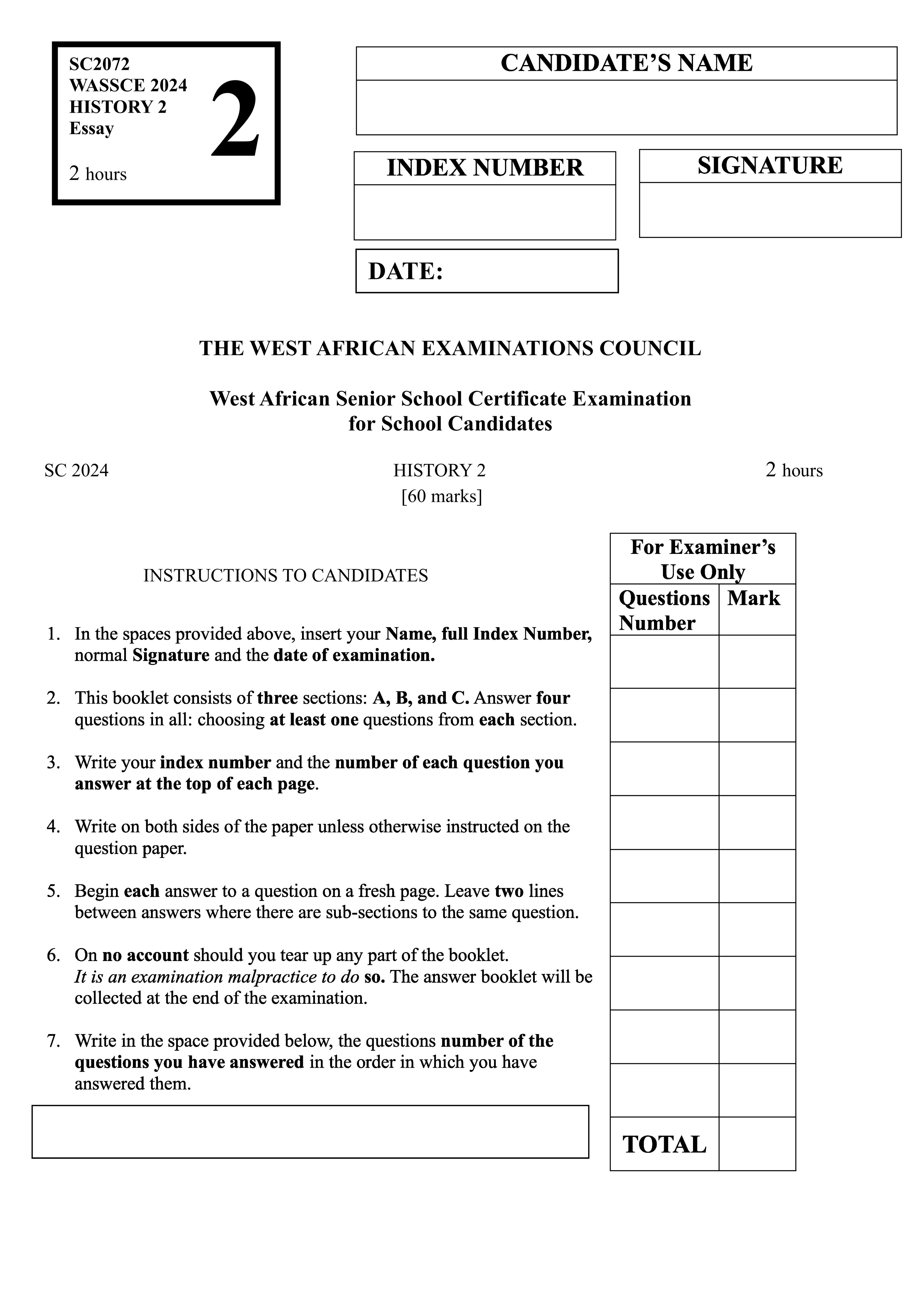
PAPER 2
Essay
[60 marks]
HISTORY OF LIBERIA
Answer four questions in all, choosing at least one question from each section.
All questions carry equal marks.
SECTION A
LIBERIA UP TO 1800
Answer at least one question from this section.
1. (a) List any three documentary sources used in writing the history of Liberia.
[3 marks]
Land Deeds and Agreements - Documents showing agreements between the ACS and indigenous leaders for land acquisition in Liberia.
Indigenous Oral Histories - Stories passed down by local African tribes that were recorded by Europeans.
Maps - Early maps created by European explorers to show the West African coast, including Liberia.
1. (b) Highlight any four misconceptions about Liberia and her people which can be corrected through the study of Liberian history.
[12 marks]
Liberia was colonized by America:
Liberia was founded by the American Colonization Society to resettle freed African Americans. Although it maintained close ties with the U.S., Liberia was an independent nation, officially declaring its independence in 1847.
All Liberians are descended from African Americans:
While many Liberians are descended from African Americans who settled in the country, there is a large population of indigenous Liberians who have their own rich history and cultural traditions.
Liberia was a European colony:
Liberia was never a European colony, although it was influenced by European powers through the transatlantic slave trade. It was a project of the American Colonization Society to resettle freed African Americans.
Liberia's indigenous peoples were always hostile to settlers:
While there were some conflicts, many indigenous groups interacted peacefully with the settlers. Over time, however, tensions grew due to differences in governance, culture, and land ownership.
2. Identify any five methods used by the indigenous Liberians to communicate among themselves.
[15 marks]
Drums: Drums were used to send messages over long distances. Different drum rhythms could represent words or ideas, and they were often used to announce events like celebrations or dangers.
Symbols and Carvings: People used symbols and carvings on trees or rocks to communicate. These marks could represent events, directions, or important messages for the community.
Songs and Chants: Songs and chants helped share stories and important news. They were passed down through generations and were often used during rituals or to convey emotions.
Smoke Signals: Smoke signals were used to send messages across long distances. By controlling the smoke's color and shape, people could signal warnings or gather others for meetings.
Messengers: Messengers would run between villages to deliver important news. They used well-known paths and could travel quickly to bring messages about emergencies or community events.
3. Highlight any five negative effects of the trans-Atlantic slave trade in Liberia.
[15 marks]
Loss of Lives: Many people were forcibly taken from their homes, often through violent raids by other African groups or European traders. These attacks led to deaths and injuries.
Family Separation: Families were often split up during the slave trade, and many children never saw their parents again.
Depopulation: Large numbers of people were taken away as slaves, leaving communities weakened and populations smaller.
Increased Conflict: The demand for slaves led to more fighting among tribes, as some groups raided others to capture slaves.
Weakening of Local Governments: The trade caused instability and made it harder for local leaders to maintain control, leading to weakened governance.
SECTION B
LIBERIA IN THE 19TH CENTURY
Answer at least one question from this section.
4. (a) Name any three indigenous rulers who signed the Treaty of Cooperation with the Common Wealth of Liberia on April 6, 1840.
[3 marks]
King Sao Boso of the Dey tribe
King Long Peter of the Bassa tribe
King Jimmy of the Kru tribe
4. (b) In what four ways did the 1840 Treaty of Cooperation improve relations between the Settlers and the indigenous groups?
[12 marks]
The 1840 Treaty of Cooperation improved relations between settlers and indigenous.
Respect for Leaders: The treaty recognized the authority of both the settlers and indigenous chiefs. This mutual respect helped to reduce tensions and foster cooperation between the groups.
Peaceful Trading: It encouraged trade between settlers and indigenous communities, allowing both sides to benefit economically. This created a sense of partnership and reduced misunderstandings over trade practices.
Sharing Land Fairly: Both parties agreed on how to use and share land, reducing arguments over territory. This agreement created clear boundaries and avoided land disputes.
Working Together for Safety: The treaty united settlers and indigenous groups to protect their communities from outside threats. By cooperating, they strengthened their defenses and ensured mutual safety.
5. (a) Name any three founders of the True Whig Party (TWP).
[3 marks]
Edward James Roye
Anthony W. Gardiner
Hilary R. W. Johnson
5. (b) Highlight any four problems encountered by the First True Whig Party government (1870-1871).
[12 marks]
Ethnic Tensions: The settlers from America had most of the power, which upset the local African groups. These groups felt left out and treated unfairly.
Economic Struggles: Liberia had a weak economy with poor roads and farming that couldn't support the country. The government didn't have enough money to improve things.
Corruption: Government officials were often accused of misusing public funds for personal gain, weakening the trust in the administration. This corruption hindered the government's ability to effectively address the country's challenges.
Diplomatic Issues: Liberia struggled to maintain good relations with European colonial powers and protect its sovereignty.
6. (a) List any three articles of trade that the Settlers of the Colony of Liberia exchanged for indigenous goods.
[3 marks]
Firearms: The settlers often exchanged firearms, such as muskets and guns, with the indigenous peoples. These weapons were valuable for protection and hunting.
Cloth: Fabric, especially European-made cloth, was a common trade item. It was highly sought after for clothing and other uses by indigenous communities.
Iron Tools: Items such as knives, hatchets, and other metal tools were exchanged, offering indigenous people access to more durable and efficient implements for agriculture, craftwork, and daily life.
6. (b) Outline any four reasons responsible for the Settlers' preference to trade over agriculture.
[12 marks]
Lack of Farming Knowledge: Many settlers didn't know how to farm in Liberia's tropical climate. Because of this, trading seemed easier than learning how to grow crops.
Access to European Goods: The settlers had quick access to goods like guns and cloth from Europe, which they could trade with the indigenous people. This made trading a fast way to earn resources without having to grow food or farm.
Difficult Land and Weather: Liberia's rainy weather and thick forests made farming hard. Settlers preferred trading instead of dealing with these problems.
Short-Term Economic Gain: The settlers wanted quick profits instead of waiting for crops to grow, which could take a long time. Trading allowed them to earn goods and money much faster than farming did.
SECTION C
LIBERIA IN THE 20TH CENTURY
Answer at least one question from this section.
7. (a) List any three private Liberian citizens involved in the Fernando Po Labor scandal.
[3 marks]
Samuel S. P. Roberts - He was one of the key individuals who played a role in recruiting Liberian citizens for the labor trade, often under deceptive conditions.
James W. Johnson - He was another individual linked to the recruitment of workers, assisting in the transport of Liberians to Fernando Po for labor exploitation.
Cecil P. Smith - Smith was involved in facilitating the recruitment and transportation of Liberian workers to Fernando Po, where they were subjected to harsh working conditions.
7. (b) Highlight any four political reforms outlined in the League of Nations' Christy Commission recommendations.
[12 marks]
Promotion of Democratic Governance: The Commission stressed the need for enhancing democratic principles and institutions in countries where autocratic regimes existed, encouraging the establishment of more representative governments.
Electoral Reforms: The Commission recommended changing how elections are held to make them fairer. This included ensuring that everyone has an equal chance to vote and that election results truly represent the will of the people.
Protection of Minority Rights: The Commission emphasized the importance of protecting the rights of minority groups in countries with many different ethnic or religious groups. It called for laws that ensure minorities are treated fairly and have their political rights respected.
Strengthening International Cooperation: The Commission encouraged countries to work together peacefully through agreements and diplomacy. This would help prevent wars and promote a more cooperative and peaceful world.
8. Outline any five negative impact of the Firestone Agreement of 1926 on the people of Liberia
[15 marks]
Exploitation of Labor: Firestone paid workers very low wages and made them work long hours. The workers were treated unfairly and did not earn much for their hard work.
Loss of Land: Firestone took control of a million acres of land, pushing local people off their land. Many Liberians lost access to their homes and farmland.
Unequal Economic Benefits: While Firestone made a lot of money, most Liberians did not benefit. Only a few rich people in Liberia saw any real profits from the deal.
Health and Sanitation Issues: Workers on the plantations lived in poor conditions and were exposed to diseases. There was not enough medical care or clean water for them to stay healthy.
Political Corruption: Some government officials took bribes from Firestone to keep the deal going. This led to unfair decisions that hurt the average Liberian.
9. Highlight any five reasons for the invasion of Liberia by the National Patriotic Front of Liberia (NPFL).
[15 marks]
Political Discrimination: Many groups in Liberia felt left out by the government of President Samuel Doe. The NPFL wanted to create a more inclusive government where all groups had a voice.
Corruption in Doe's Government: President Doe's government was seen as corrupt and unfair. Liberia's wealth was concentrated in a few hands, leaving most people in poverty. The NPFL aimed to overthrow him and stop the abuse of power and resources.
Tribalism: President Doe, who was from the Krahn ethnic group, was accused of treating other groups like the Mandingos and the Gio unfairly. The NPFL wanted to end the discrimination and promote equality among all groups.
Suppression of Opposition: Samuel Doe's government silenced anyone who disagreed with him. The NPFL felt that armed resistance was the only way to challenge this oppressive government.
Lack of Free and Fair Elections: President Doe's government was criticized for not holding fair elections and blocking opposition parties from participating. Many people felt that the only way to change the corrupt system was through rebellion.
Our Mission: To provide free, accessible, and comprehensive exam preparation resources for West African students preparing for their WASSCE and LJHSCE examinations.
StudyWASSCE was created in 2023 by an independent content creator who recognized a critical gap in accessible educational resources for West African students. After witnessing countless students struggle to find quality past examination papers and affordable study materials, I dedicated myself to building a comprehensive, completely free platform that would level the playing field for all students, regardless of their economic background.
As an independent educational content creator, I have invested countless hours researching, compiling, and organizing past examination papers from official sources. My commitment stems from a deep belief that every student deserves access to quality educational resources, regardless of their financial circumstances.
Unlike general educational platforms, StudyWASSCE specializes exclusively in:
StudyWASSCE operates on a sustainable model that keeps education free while ensuring quality:
Since launching, StudyWASSCE has:
As an independent creator, I am committed to:
We welcome partnerships with:
As the independent creator behind StudyWASSCE, I personally respond to:
Response Commitment: I personally review and respond to all messages within 48-72 hours.
Education transformed my life, and I believe it can transform the lives of every student who has access to quality resources. StudyWASSCE represents my personal commitment to ensuring that no student is left behind due to lack of access to study materials. Every hour I spend improving this platform is an investment in the future of West African education.
Thank You for Your Support! By using StudyWASSCE and viewing our advertisements, you help sustain this free educational resource. Your success is our success, and every student who passes their examinations using our materials validates our mission.
StudyWASSCE: Created by an independent educator, for students everywhere.
Empowering West African students through free, accessible education.
StudyWASSCE is an independent educational platform created to provide free access to past exam papers and study materials for WASSCE and LJHSCE examinations. We are committed to helping students succeed while maintaining transparency about our data practices.
To improve our service and comply with advertising requirements, we collect the following information:
We use collected information to:
Our site is supported by advertising to keep educational content free. We work with the following third-party services:
We do not sell or rent personal information. We may share data with:
Required for Site Access: By using StudyWASSCE, you consent to our data collection practices as described in this policy. This includes:
Your Options:
Note: Continued use of our platform indicates your ongoing consent to these practices.
We implement appropriate technical and organizational security measures to protect the information we collect. However, no internet transmission is completely secure, and we cannot guarantee absolute security.
Our site is designed for students of all ages. We do not knowingly collect personal information from children under 13 without parental consent. If you believe we have collected such information, please contact us immediately.
Our site is hosted and operated from servers that may be located in different countries. By using our site, you consent to the transfer of your information to these locations.
We may update this privacy policy periodically to reflect changes in our practices or legal requirements. We will post any changes on this page with an updated revision date. Continued use of our site after changes constitutes acceptance of the updated policy.
If you have any questions about this privacy policy or our data practices, please contact us via WhatsApp at +231-770450825, by email at davidlamine96@gmail.com, or through our Facebook page @Study For WASSCE.
Last Updated: January 15, 2025
Important Notice: By using StudyWASSCE, you agree to these Terms of Service and our Privacy Policy. This site uses cookies and displays advertisements to provide free educational content.
StudyWASSCE is an independent educational platform created and maintained by a dedicated content creator who has worked extensively to compile and organize past examination papers for WASSCE (West African Senior School Certificate Examination) and LJHSCE (Liberian Junior High School Certificate Examination). Our mission is to provide free access to quality educational resources for students preparing for these national examinations.
All examination papers, questions, and educational materials on this platform have been carefully curated from publicly available past examination papers. We provide:
By accessing, browsing, or using StudyWASSCE in any way, you acknowledge that you have read, understood, and agree to be bound by these Terms of Service and our Privacy Policy. If you do not agree to these terms, please discontinue use of our platform immediately.
StudyWASSCE provides completely free access to all educational content. You are not required to:
To maintain this free service, StudyWASSCE is supported by:
Required for Free Access: Advertisements are essential to maintaining our free educational service. By using StudyWASSCE, you consent to the display of advertisements throughout the platform.
Our advertising practices comply with Google AdSense policies:
Essential for Site Operation: StudyWASSCE uses cookies for:
By using our site, you consent to our use of cookies as described in our Privacy Policy.
StudyWASSCE grants you a limited, non-exclusive, non-transferable license to access and use our content for personal educational purposes only. You may:
You may NOT:
While individual examination questions may be public domain, our compilation, organization, explanations, and presentation represent original work protected by intellectual property rights.
We use Google Analytics to collect anonymous usage data to improve our educational content and user experience. This includes:
We use this data to:
Users must:
StudyWASSCE is designed for students of all ages. Users under 13 should have parental consent before using our platform, particularly regarding cookie acceptance and data collection.
While we strive for accuracy in all educational content:
Important: StudyWASSCE is a study supplement and should not replace formal education, textbooks, or qualified instruction. Users should use our resources alongside official study materials and classroom learning.
We strive to maintain consistent platform availability, but cannot guarantee:
We reserve the right to:
We are committed to protecting user privacy while providing free educational services. Our data collection practices are detailed in our Privacy Policy and comply with:
Our platform integrates with reputable third-party services that have their own privacy policies:
StudyWASSCE is provided "as is" for educational purposes. We disclaim liability for:
In no event shall StudyWASSCE be liable for any indirect, incidental, special, or consequential damages arising from platform use, even if advised of the possibility of such damages.
Our advertising practices comply with:
We respect intellectual property rights and maintain compliance with copyright laws regarding educational fair use of examination materials.
We regularly update our platform with:
We reserve the right to modify these Terms of Service to:
Updated terms will be posted on this page with revision dates. Continued use after changes constitutes acceptance of updated terms.
These Terms of Service shall be governed by and construed in accordance with the laws of the Republic of Liberia. Any disputes arising from these terms or platform use shall be subject to the jurisdiction of Liberian courts.
If any provision of these Terms of Service is found to be unenforceable or invalid, that provision shall be limited or eliminated to the minimum extent necessary so that the remaining terms remain in full force and effect.
These Terms of Service, together with our Privacy Policy, constitute the entire agreement between you and StudyWASSCE regarding platform use and supersede all prior agreements or understandings.
For questions about these Terms of Service, content issues, or platform feedback, please contact us through:
For Urgent Issues: Technical problems affecting site access, inappropriate advertisements, or content errors.
For Partnership Inquiries: Educational institutions, content contributors, or collaboration opportunities.
Thank you for using StudyWASSCE! Your use of our platform helps us continue providing free educational resources to students across West Africa. We appreciate your support through advertisement viewing and ethical use of our content.
© 2025 StudyWASSCE. All rights reserved.
Supporting West African education through free access to quality study materials.