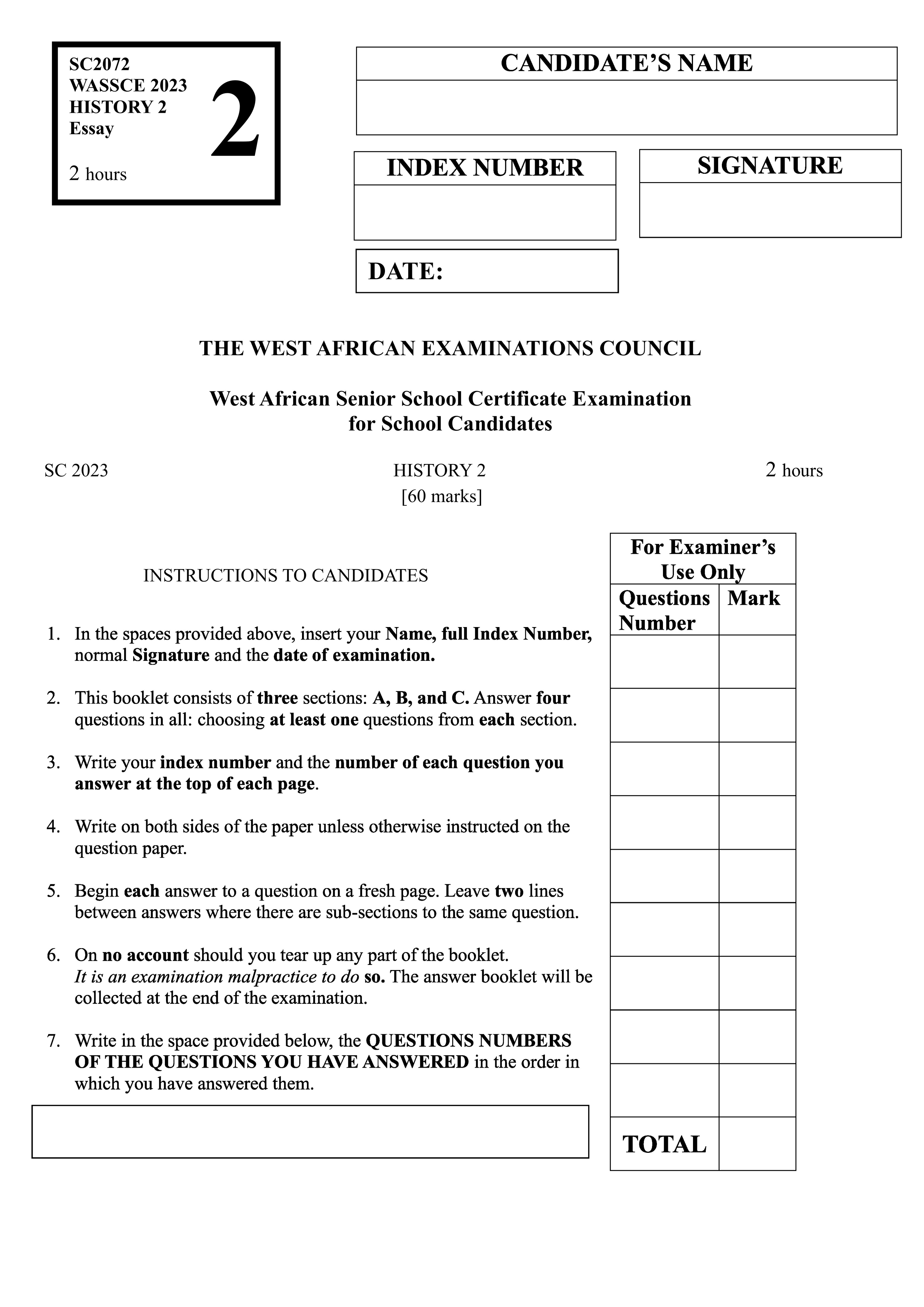
PAPER 2
Essay
[60 marks]
HISTORY OF LIBERIA
Answer four questions in all, choosing at least one question from each section.
All questions carry equal marks.
SECTION A
LIBERIA UP TO 1800
Answer at least one question from this section.

1. (a) List any three material remains that are objects of archaeological studies.
[3 marks]
Iron and Copper Artifacts – Tools, weapons, and jewelry made from iron and copper provide evidence of local metalworking practices. These materials show advancements in technology and trade in the region during the pre-colonial and early colonial periods.
Human Remains – Skeletons or burial sites can offer insight into the physical anthropology of past populations, as well as burial practices, health, and social organization.
Stone Tools – Early stone tools such as axes, scrapers, and grinding stones were used by pre-colonial societies in Liberia for tasks like hunting, fishing, and processing food.
1. (b) Identify any four problems associated with archaeology.
[12 marks]
Preservation of Sites and Artifacts – Many artifacts and sites break down over time due to weather or natural decay. This makes it hard to study and preserve them for the future.
Looting and Illegal Excavation – Some people dig up and steal artifacts illegally. This destroys important information and prevents proper study.
Funding and Resources – Archaeological digs require a lot of money and equipment. Without enough funds, many important sites can't be properly explored.
Bias and Interpretation – Archaeologists might see things in their own way, which can affect how they understand the past. Different people might interpret the same evidence in different ways.
2. Identify any five roles performed by the Poro Society in the development of the traditional Liberian society.
[15 marks]
Teaching Boys to Become Men: The Poro Society helped young boys grow into men. They taught them how to be responsible adults through special ceremonies and lessons.
Passing on Culture and Traditions: The Poro Society helped teach young people about the customs, stories, and history of their people, keeping their culture alive.
Teaching Right and Wrong: Members of the Poro Society taught young people the rules of good behavior, like being honest, respectful, and brave, to help keep peace in the community.
Solving Problems: The Poro Society helped solve problems and settle fights between people. They made sure everyone followed the community's rules and lived in peace.
Helping with Work and Cooperation: The Poro Society encouraged people to work together, like farming and sharing resources. This helped the whole community work better together.
3. Highlight any five features of Islam in Liberia before 1800.
[15 marks]
Brought by Traders: Islam came to Liberia mainly through traders who traveled from other parts of Africa, like Mali and Guinea. These traders brought Islamic ideas and practices with them.
Mande People's Influence: The Mande people, who already followed Islam, played a big role in spreading the religion in Liberia. They settled in different areas and shared their faith with the locals.
Presence in the Interior: While many Muslims lived in towns along the coast, there were also Muslim communities in the interior parts of Liberia. These communities were found especially near the borders with Guinea and Sierra Leone.
Mixing with Local Beliefs: In Liberia, some people mixed Islamic practices with their traditional African beliefs. For example, they might have combined Islamic prayers with local customs, creating a mix of religious practices.
Impact on Society: Islam influenced the way people lived, especially in trade and social practices. Muslims followed special rules about food, dress, and prayer, and these influenced local culture, especially in the northern areas of Liberia.
SECTION B
LIBERIA IN THE 19TH CENTURY
Answer at least one question from this section.
4. Highlight any five factors responsible for the expansion of the Liberian territory between 1822 and 1839.
[15 marks]
American Colonization Society (ACS): The ACS sent free African Americans and former slaves to Africa to start a new life. In 1822, they set up a colony in Liberia, which grew as more people arrived.
Land Deals with Local People: The settlers made agreements with local African groups to buy land. Over time, they gained more land for farming and building settlements.
Defending the Settlements: The settlers had to protect themselves from local tribes who resisted their presence. To do this, they created militias and forts, which helped them control more land.
European Competition: European countries like Britain and France wanted to control parts of West Africa. Liberia needed to defend its land and make sure other countries didn't take it.
More Settlers Arriving: As more free African Americans came to Liberia, they created new settlements and helped the colony expand by claiming more land.
5. Outline any five reasons that motivated the formation of the Commonwealth in 1839.
[15 marks]
Unification of Settlements: The need to unite the various settlements established by freed African Americans along the coast, such as Monrovia, Greenville, and Buchanan, motivated the formation. This unity strengthened the governance and coordination of resources.
Protection from External Threats: The settlers faced threats from indigenous groups and European colonial powers. The Commonwealth provided a collective defense structure to ensure the security and stability of the settlements.
Self-Governance: The desire for greater autonomy from the American Colonization Society (ACS) influenced the creation of the Commonwealth. It allowed settlers to exercise more control over their political and economic affairs.
Economic Development: The settlers wanted to work together to improve farming, trade, and business opportunities to make life better for everyone. They believed a strong economy would help the settlements grow and become more self-sufficient.
Creating a Shared Identity: The Commonwealth sought to foster a collective identity among settlers of African descent. The settlers aimed to create a sense of unity by embracing their shared history and culture. They wanted to build a community where everyone felt connected and worked together to establish a new home.
6. In what five ways did the Americo-Liberian settlers influence the indigenous people of Liberia?
[15 marks]
Political Changes: The settlers created a new government based on the United States, with a president and a constitution. This system took power away from the local leaders and gave it to the settlers.
Culture and Religion: The settlers introduced Christianity and Western ways of life. They built schools that taught English and often looked down on indigenous beliefs and traditions.
Land Ownership: The settlers took land from indigenous people to build farms and settlements. Many indigenous groups were forced to move and work for the settlers on their land.
Economic Changes: The settlers started large farms growing crops like rubber, which changed how people made a living. Indigenous people were sometimes forced to work on these farms for little pay.
Education and Language: The settlers set up schools that taught in English, not local languages. This made it harder for indigenous people to keep their own languages and ways of learning.
SECTION C
LIBERIA IN THE 20TH CENTURY
Answer at least one question from this section.
7. (a) Identify any two demands made to president Daniel E Howard by the German Submarine Captain in April, 1918.
[3 marks]
Cutting Ties with Allied Powers: The German submarine captain demanded that President Daniel E. Howard break diplomatic relations with the Allied nations, such as Britain and France. This was an attempt to pressure Liberia into supporting Germany during the war
Providing Supplies for the Submarine: The captain requested provisions, including food and fuel, to resupply the German submarine. He expected Liberia to assist German forces by providing these resources.
7. (b) In what three ways did Liberia help the Allies in the fight against Germany during the Second World War?
[12 marks]
Providing Military Support: Liberia allowed the Allies to set up military bases on its land. These bases helped the Allies keep an eye on German ships and planes in the Atlantic Ocean.
Economic Assistance and Resources: Liberia had large rubber plantations, which were very important during the war. The Allies used the rubber to make tires and other materials needed for military vehicles and equipment.
Declaring War on Germany: In 1944, Liberia officially declared war on Germany. This showed that Liberia supported the Allied powers and wanted to help defeat Germany in the war.
8. Outline any five major political developments that took place in Liberia between 1980 and 1990.
[15 marks]
The 1980 Military Coup: In 1980, Samuel Doe and his soldiers took over the government by force, removing President William Tolbert from power. This marked the end of 133 years of rule by the True Whig Party and started military rule in Liberia.
Execution of Government Officials: After taking power, Samuel Doe ordered the execution of former President Tolbert and other government officials. This was done to show control and punish those who opposed the coup.
The 1985 Presidential Elections: Samuel Doe held elections in 1985 to appear more democratic, but many people believed the vote was unfair and rigged. Despite these claims, Doe won and remained in power.
The Outbreak of the Liberian Civil War (1989): In 1989, Charles Taylor led a group of rebels to fight against Doe's government, starting the Liberian Civil War. The war quickly became brutal, with many people suffering from violence and displacement.
Intervention by ECOWAS and the Accra Agreement (1990): In 1990, a group of West African countries, led by ECOWAS, sent peacekeepers to try to stop the war in Liberia. After fighting continued, the warring sides agreed to a ceasefire, but peace was not fully achieved until later.
9. Highlight any five reasons that motivated Liberia to be a member of the Organization of African Unity
[15 marks]
Pan-Africanism and Solidarity: Liberia believed in the idea of African unity and working together as a continent. By joining the OAU, Liberia wanted to support and be part of a group that worked for peace and cooperation among African countries.
Promotion of African Independence: Liberia wanted to help other African nations that were still under colonial rule to gain independence. Joining the OAU gave Liberia a chance to support the fight for freedom across the continent.
Economic Cooperation: Liberia hoped to improve its economy by working together with other African nations. Being part of the OAU allowed Liberia to trade and share resources, which could help its economic growth.
Political Influence: Liberia wanted to have a say in important decisions affecting Africa. Joining the OAU gave Liberia the chance to be involved in discussions and decisions that shaped Africa's future.
Security and Stability: Liberia wanted to work with other African countries to solve problems like wars or conflicts. Through the OAU, Liberia could help create a safer and more stable continent for everyone.
Our Mission: To provide free, accessible, and comprehensive exam preparation resources for West African students preparing for their WASSCE and LJHSCE examinations.
StudyWASSCE was created in 2023 by an independent content creator who recognized a critical gap in accessible educational resources for West African students. After witnessing countless students struggle to find quality past examination papers and affordable study materials, I dedicated myself to building a comprehensive, completely free platform that would level the playing field for all students, regardless of their economic background.
As an independent educational content creator, I have invested countless hours researching, compiling, and organizing past examination papers from official sources. My commitment stems from a deep belief that every student deserves access to quality educational resources, regardless of their financial circumstances.
Unlike general educational platforms, StudyWASSCE specializes exclusively in:
StudyWASSCE operates on a sustainable model that keeps education free while ensuring quality:
Since launching, StudyWASSCE has:
As an independent creator, I am committed to:
We welcome partnerships with:
As the independent creator behind StudyWASSCE, I personally respond to:
Response Commitment: I personally review and respond to all messages within 48-72 hours.
Education transformed my life, and I believe it can transform the lives of every student who has access to quality resources. StudyWASSCE represents my personal commitment to ensuring that no student is left behind due to lack of access to study materials. Every hour I spend improving this platform is an investment in the future of West African education.
Thank You for Your Support! By using StudyWASSCE and viewing our advertisements, you help sustain this free educational resource. Your success is our success, and every student who passes their examinations using our materials validates our mission.
StudyWASSCE: Created by an independent educator, for students everywhere.
Empowering West African students through free, accessible education.
StudyWASSCE is an independent educational platform created to provide free access to past exam papers and study materials for WASSCE and LJHSCE examinations. We are committed to helping students succeed while maintaining transparency about our data practices.
To improve our service and comply with advertising requirements, we collect the following information:
We use collected information to:
Our site is supported by advertising to keep educational content free. We work with the following third-party services:
We do not sell or rent personal information. We may share data with:
Required for Site Access: By using StudyWASSCE, you consent to our data collection practices as described in this policy. This includes:
Your Options:
Note: Continued use of our platform indicates your ongoing consent to these practices.
We implement appropriate technical and organizational security measures to protect the information we collect. However, no internet transmission is completely secure, and we cannot guarantee absolute security.
Our site is designed for students of all ages. We do not knowingly collect personal information from children under 13 without parental consent. If you believe we have collected such information, please contact us immediately.
Our site is hosted and operated from servers that may be located in different countries. By using our site, you consent to the transfer of your information to these locations.
We may update this privacy policy periodically to reflect changes in our practices or legal requirements. We will post any changes on this page with an updated revision date. Continued use of our site after changes constitutes acceptance of the updated policy.
If you have any questions about this privacy policy or our data practices, please contact us via WhatsApp at +231-770450825, by email at davidlamine96@gmail.com, or through our Facebook page @Study For WASSCE.
Last Updated: January 15, 2025
Important Notice: By using StudyWASSCE, you agree to these Terms of Service and our Privacy Policy. This site uses cookies and displays advertisements to provide free educational content.
StudyWASSCE is an independent educational platform created and maintained by a dedicated content creator who has worked extensively to compile and organize past examination papers for WASSCE (West African Senior School Certificate Examination) and LJHSCE (Liberian Junior High School Certificate Examination). Our mission is to provide free access to quality educational resources for students preparing for these national examinations.
All examination papers, questions, and educational materials on this platform have been carefully curated from publicly available past examination papers. We provide:
By accessing, browsing, or using StudyWASSCE in any way, you acknowledge that you have read, understood, and agree to be bound by these Terms of Service and our Privacy Policy. If you do not agree to these terms, please discontinue use of our platform immediately.
StudyWASSCE provides completely free access to all educational content. You are not required to:
To maintain this free service, StudyWASSCE is supported by:
Required for Free Access: Advertisements are essential to maintaining our free educational service. By using StudyWASSCE, you consent to the display of advertisements throughout the platform.
Our advertising practices comply with Google AdSense policies:
Essential for Site Operation: StudyWASSCE uses cookies for:
By using our site, you consent to our use of cookies as described in our Privacy Policy.
StudyWASSCE grants you a limited, non-exclusive, non-transferable license to access and use our content for personal educational purposes only. You may:
You may NOT:
While individual examination questions may be public domain, our compilation, organization, explanations, and presentation represent original work protected by intellectual property rights.
We use Google Analytics to collect anonymous usage data to improve our educational content and user experience. This includes:
We use this data to:
Users must:
StudyWASSCE is designed for students of all ages. Users under 13 should have parental consent before using our platform, particularly regarding cookie acceptance and data collection.
While we strive for accuracy in all educational content:
Important: StudyWASSCE is a study supplement and should not replace formal education, textbooks, or qualified instruction. Users should use our resources alongside official study materials and classroom learning.
We strive to maintain consistent platform availability, but cannot guarantee:
We reserve the right to:
We are committed to protecting user privacy while providing free educational services. Our data collection practices are detailed in our Privacy Policy and comply with:
Our platform integrates with reputable third-party services that have their own privacy policies:
StudyWASSCE is provided "as is" for educational purposes. We disclaim liability for:
In no event shall StudyWASSCE be liable for any indirect, incidental, special, or consequential damages arising from platform use, even if advised of the possibility of such damages.
Our advertising practices comply with:
We respect intellectual property rights and maintain compliance with copyright laws regarding educational fair use of examination materials.
We regularly update our platform with:
We reserve the right to modify these Terms of Service to:
Updated terms will be posted on this page with revision dates. Continued use after changes constitutes acceptance of updated terms.
These Terms of Service shall be governed by and construed in accordance with the laws of the Republic of Liberia. Any disputes arising from these terms or platform use shall be subject to the jurisdiction of Liberian courts.
If any provision of these Terms of Service is found to be unenforceable or invalid, that provision shall be limited or eliminated to the minimum extent necessary so that the remaining terms remain in full force and effect.
These Terms of Service, together with our Privacy Policy, constitute the entire agreement between you and StudyWASSCE regarding platform use and supersede all prior agreements or understandings.
For questions about these Terms of Service, content issues, or platform feedback, please contact us through:
For Urgent Issues: Technical problems affecting site access, inappropriate advertisements, or content errors.
For Partnership Inquiries: Educational institutions, content contributors, or collaboration opportunities.
Thank you for using StudyWASSCE! Your use of our platform helps us continue providing free educational resources to students across West Africa. We appreciate your support through advertisement viewing and ethical use of our content.
© 2025 StudyWASSCE. All rights reserved.
Supporting West African education through free access to quality study materials.