PAPER 2
[80 marks]
Answer four questions in all. One question only from Section A and any three questions from section B.
You are reminded of the importance of clarity of expression and orderly presentation of relevant materials.
All questions carry equal marks.
SECTION A
Answer One question only from this section.
1. Figure 1 below shows the imposition of tax on the sellers of a product. Study the graph and answer the questions that follow.
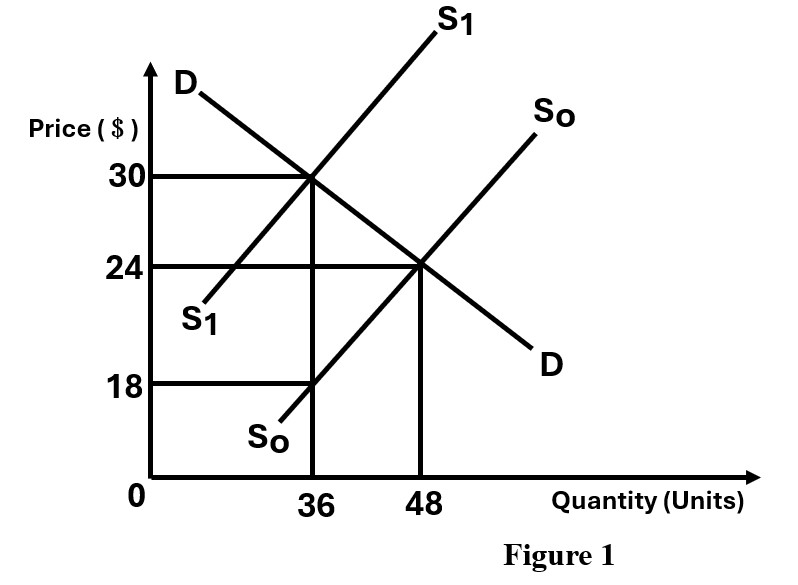
(1) (a) Identify the price per unit of the product:
i. before-tax;
[2 marks]
ii. after-tax
[2 marks]
(1) (b) What is the quantity demanded and supplied:
i. before-tax;
[2 marks]
ii. after-tax?
[2 marks]
(1) (c) Determine the amount:
i. of tax imposed per unit of the product;
[2 marks]
ii. retained per unit by the sellers after tax.
[2 marks]
(1) (d) Calculate the percentage of the total tax imposed that is:
i. paid by the buyers per unit;
[4 marks]
ii. paid by the sellers per unit.
[4 marks]
(2) (a) Calculate the:
i. percentage increase in the price of its service;
[2 marks]
ii. percentage decrease in the number of commuters;
[3 marks]
iii. coefficient of price elasticity of demand for its service.
[3 marks]
(2) (b) Is the demand for the company's transport service price elastic or inelastic?
[2 marks]
(2) (c) What is the effect of the increase in the price of its transport service on the company's revenue?
[6 marks]
(2) (d) From your answers in 2(a)(iii), is it rational for the transport company to increase the price of its service in order to increase revenue?
[4 marks]
(3) (a) Explain how inflation can lead to unemployment.
[4 marks]
(3) (b) Other things being equal, an increase in demand will cause equilibrium price and quantity to rise.
With the aid of diagrams, explain the extent of this rise when supply is:
a. fairly elastic [8 marks]
b. fairly inelastic [8 marks]
a. Fairly Elastic Supply:
If supply is elastic, producers can make more products easily when demand rises.
So, the quantity sold goes up a lot, but the price only rises a little.
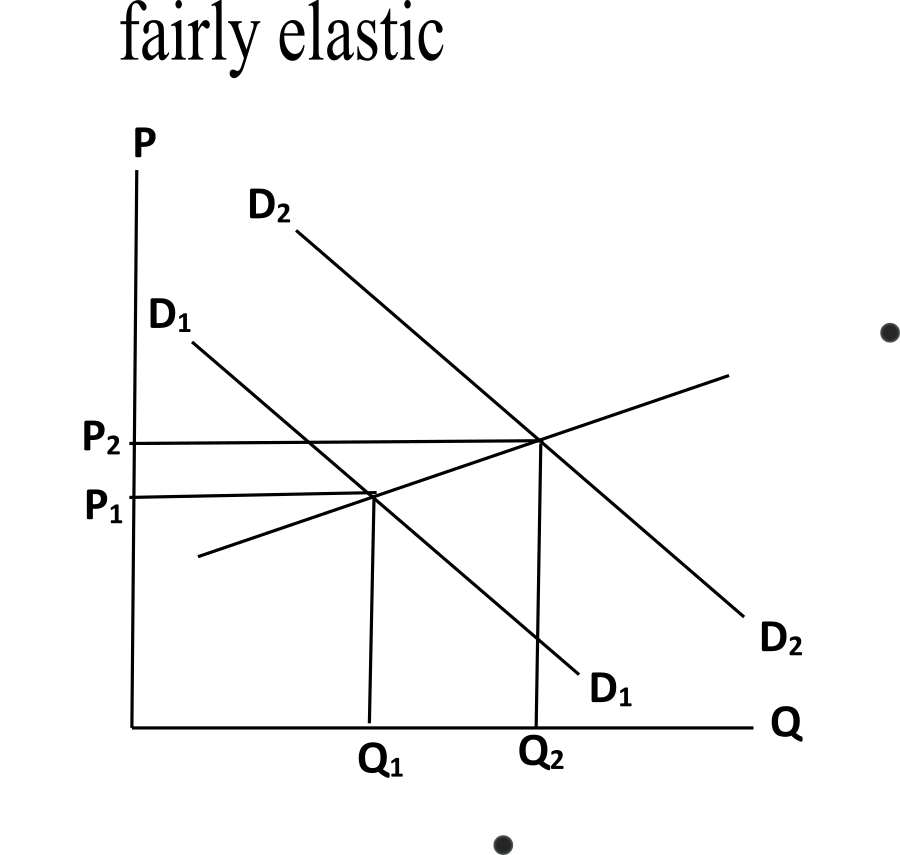
The price stays almost the same, but quantity increases a lot.
b. Fairly Inelastic Supply:
If supply is inelastic, producers cannot make much more even if demand rises.
So, the price goes up a lot, but the quantity only goes up a little.
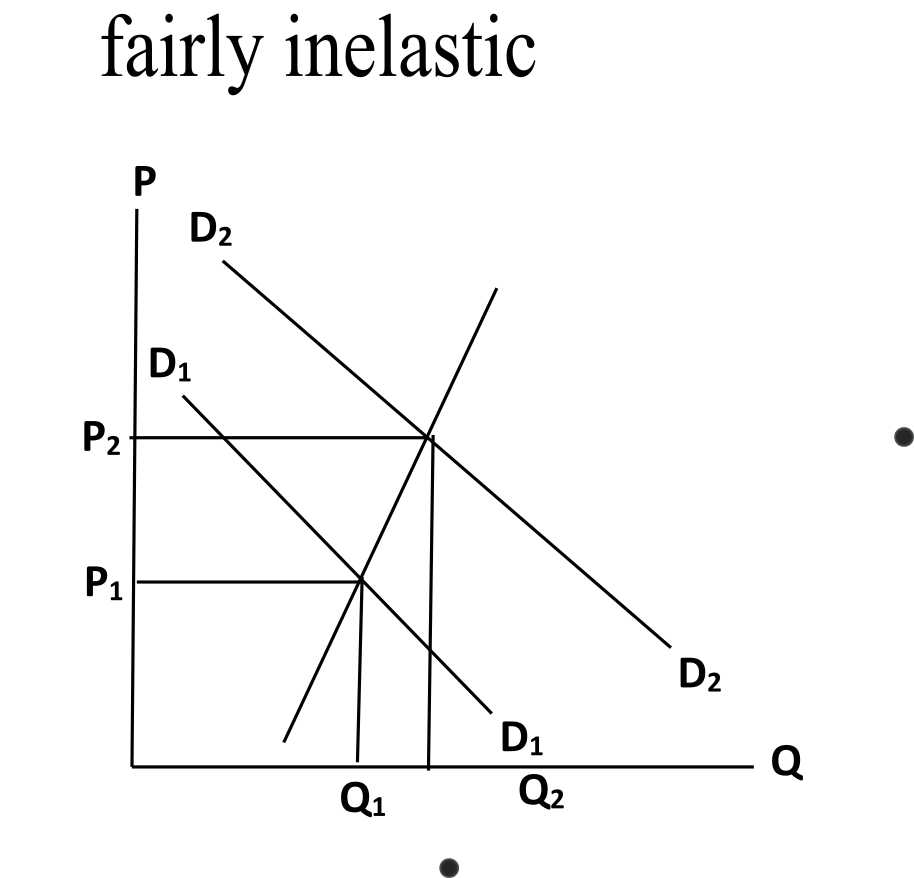
The price rises a lot, but quantity barely changes.
Summary: When supply is elastic, price changes less and quantity changes more. When supply is inelastic, price changes more and quantity changes less.
(4) (a) Distinguish between a monopoly and monopolistic competition.
[6 marks]
(4) (b) Describe how the downward sloping demand curve of a monopolist limits his monopoly power.
[5 marks]
(4) (c) Explain how the following factors influence the price in a perfect market:
i. homogeneity of products sold;
[3 marks]
ii. large number of buyers and sellers;
[3 marks]
iii. perfect knowledge.
[3 marks]
(5) (a) Define labour.
[2 marks]
(5) (b) Differentiate between division of labour and efficiency of labour.
[6 marks]
(5) (c) Outline four ways in which a Chief Executive Officer of a company can make his employees more efficient.
[12 marks]
(6) (a) Define industrialization.
[2 marks]
(6) (b) Other than import substitution, explain any two strategies that can be adopted to reduce reliance on imports.
[6 marks]
(6) (c) Outline any four measures that can be adopted to increase the volume of exports in any country.
[12 marks]
(7) (a) Define economic growth.
[2 marks]
(7) (b) Explain any three roles performed by commercial banks to aid economic growth.
[9 marks]
(7) (c) Outline any three functions of the capital market in promoting economic growth.
[9 marks]
(8) (a) Define economic integration.
[2 marks]
(8) (b) Explain the following forms of integration:
i. free trade area;
[3 marks]
ii. customs union;
[3 marks]
iii. economic union.
[3 marks]
(8) (c) Outline any three problems that prevent the Economic Community of West African States (ECOWAS) from functioning effectively.
[9 marks]